
# Diesel Particulate Filter Cleaning Service Near Me – Complete Guide, Causes & Fixes
Introduction
If you’re searching for a diesel particulate filter cleaning service near me, you’re likely dealing with a clogged DPF on a turbo diesel pickup, van, or SUV common in North America. In the United States, Canada, and parts of Mexico, DPFs are standard on newer diesel engines to meet emission requirements. This complete guide covers what a DPF is, why it gets clogged, how to identify the problem, step-by-step troubleshooting, and solid cost estimates for repair or replacement. It’s written for car owners and DIY enthusiasts who want to understand the process, weigh repair options, and avoid unnecessary bills.
What it is / Explanation
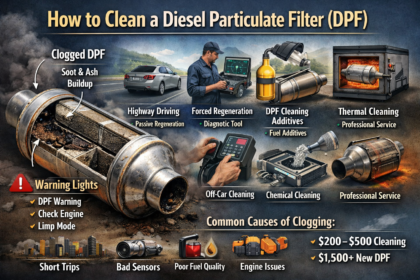
– The diesel particulate filter (DPF) is a ceramic or steel substrate housed in the exhaust system that traps soot particles produced by combustion.
– Over time, soot accumulates. The engine periodically regenerates by burning off soot at high temperatures (passive regen when you drive long distances, or active/regenerative cycles commanded by the engine control module).
– If the vehicle can’t complete a regen (due to driving patterns, faults, or a blocked filter), the DPF becomes saturated, causing reduced performance, alarm lights, and potential limp mode.
– Cleaning or replacing a DPF is not just “unclogging.” It’s about restoring flow, preserving catalyst efficiency, and preventing downstream damage to sensors, turbo, and exhaust.
Common Causes
– Short trips and urban driving: Frequent starts and short runs keep the exhaust temperatures low, preventing complete regeneration.
– Frequent stop-and-go towing: Heavier soot loads from towing modes can overwhelm the DPF.
– Faulty or dirty sensors: MAF/MAP, oxygen sensors, and pressure sensors can misread exhaust flow and trigger unnecessary or incomplete regenerations.
– EGR issues: A stuck or malfunctioning EGR valve can raise soot production and alter exhaust gas flow.
– Fuel system problems: Clogged injectors, poor fuel quality, or improper combustion increases soot production.
– Exhaust leaks or damaged DPF: Cracks, broken seals, or misaligned mounting can reduce backpressure and hamper regen.
– Ash buildup: After many regenerations, ash remains and cannot be burned off, leading to reduced DPF efficiency even if soot is cleared.
Symptoms / How to Identify the Problem
– Warning lights: Check Engine Light or a specific DPF warning/low power message on the dash.
– Power loss and limp mode: You may notice reduced acceleration, especially under load or at highway speeds.
– Increased fuel consumption: A clogged DPF can cause the engine to work harder during regenerations.
– Engine hunts or rough idle: Faulty sensors or incomplete regen can create running irregularities.
– Excessive exhaust smoke or unusual odor: If combustion is imperfect or the engine is struggling, you may see odd exhaust.
– Regeneration messages: Some vehicles report “regen in progress” or “DPF requiring maintenance.”
Step-by-step Troubleshooting Guide
– Start with diagnostics
– Use an OBD-II scanner to pull trouble codes related to DPF, EGR, or exhaust pressure.
– Note any codes pointing to exhaust pressure or catalyst efficiency.
– Check simple causes first
– Inspect for exhaust leaks and damaged piping around the DPF.
– Verify the EGR system is functioning (no sticking valve, clean passages).
– Check fuel system: injectors, fuel pressure, and quality fuel.
– Inspect the DPF itself
– If you can access the DPF, look for obvious damage, loose mounting, or collapse in the filter housing.
– If the car has a pressure differential sensor, compare pre-DPF and post-DPF readings; a high delta indicates clogging.
– Attempt a controlled regen (where safe and allowed)
– For some vehicles, a drive cycle of sustained highway speeds (60–70 mph) for 15–30 minutes follows a cold start to encourage a regen.
– If the vehicle won’t complete a regen after a few miles of steady cruise, proceed to professional cleaning.
– Decide on cleaning vs replacement
– Sooty buildup with intact filter structure: cleaning can restore flow.
– Ash buildup or structural damage: cleaning won’t restore performance; replacement is needed.
– Cleaning options (if proceeding)
– On-vehicle cleaning: high-temperature burns during a regen or chemical cleaners injected into the exhaust may improve flow but not restore all damage.
– Off-vehicle cleaning: DPF is removed and subjected to ultrasonic cleaning, thermal cleaning, or specialized chemical baths. This is typically more effective but costs more and requires a shop.
– Documentation
– Record mileage, codes, and regen attempts. This helps avoid repeating steps and informs the next service.
When Repair Is Possible vs When to Visit a Mechanic
– Repair/DIY-friendly scenarios
– Mild soot buildup with no hardware damage and a successful regen test after cleaning.
– Sensor cleaning or replacement of a faulty O2 or MAF sensor that’s causing incorrect regen cycles.
– EGR valve cleaning or replacement if it’s causing excess soot production.
– Success with a confident, safe highway drive to complete a regen.
– Visit a mechanic or DPF specialist now
– Persistent DPF clog that does not respond to a drive cycle and cleaning attempts.
– Suspected DPF ash accumulation or physical damage (cracks, collapsed channels, broken housing).
– Alarm lights persist after a regen attempt and code indicates high soot load or failed catalyst efficiency.
– Suspected exhaust leaks, catalytic converter damage, or faulty differential pressure sensor.
– When you’re unsure about disassembly, safe removal, or specialized cleaning, professional service is recommended.
Repair/Replacement Cost Estimates (USD)
– DPF cleaning service near me (on-vehicle regeneration-related cleaning)
– Basic cleaning (diagnosis plus light cleaning): $300–$600.
– More thorough service at a shop (scope, cleaning agents, and test drive): $500–$900.
– Off-vehicle DPF cleaning (removal and ultrasonic/chemical cleaning)
– Low end: $600–$1,000.
– Higher end, with testing and re-installation: $1,000–$1,500.
– DPF replacement (new DPF module)
– DPF core plus labor: $1,200–$3,000 for aftermarket parts.
– OEM DPF plus labor: $2,500–$5,000, depending on vehicle and region.
– Additional costs to consider
– Catalytic converter replacement if damaged: $1,000–$3,000.
– Exhaust system repairs (pipes, gaskets, clamps): $200–$1,000.
– Labor rates vary by region: urban areas in the U.S. tend to be higher than rural areas; expect $100–$180 per hour in many shops.
Preventive Tips
– Drive long enough for regen
– Aim for at least one sustained highway drive of 20–40 minutes every week or two, especially if you do a lot of short trips.
– Use high-quality fuel and clean injectors
– Poor fuel quality and dirty injectors increase soot and ash accumulation.
– Monitor EGR and sensors
– Have EGR valve cleaned and sensors tested during routine maintenance to prevent false regen triggers.
– Avoid excessive idling
– Prolonged idle increases soot loading without effective regen.
– Keep the exhaust system leak-free
– Inspect gaskets, clamps, and heat shields; leaks alter backpressure and can hinder DPF efficiency.
– Regular maintenance
– Follow the vehicle’s service schedule for oil changes, filter changes, and air intake cleaning; clean air means cleaner exhaust.
– Park with care
– When parking indoors, ensure the exhaust path isn’t blocked by snow or debris, which can affect backpressure and regen behavior.
FAQs
Q1: What exactly is a DPF and why does it clog?
A: A DPF traps soot particles from the engine exhaust to reduce emissions. It clogs when soot accumulation exceeds the regeneration capacity due to driving patterns, faulty components, or poor combustion.
Q2: How long does a DPF cleaning take?
A: In-shop on-vehicle cleaning can take 1–3 hours, while off-vehicle cleaning usually takes 2–6 hours plus downtime for reinstallation and testing. Time varies by vehicle make and the cleaning method used.
Q3: Will cleaning always fix the problem?
A: Not always. If the DPF has extensive ash buildup, physical damage, or damaged catalyst cells, cleaning may not restore full function. Replacement could be necessary in those cases.
Q4: How can I drive to trigger a regen?
A: A sustained highway drive at about 60–70 mph (95–115 km/h) for 15–30 minutes can help trigger a regen. If your vehicle allows, a longer drive of 20–40 minutes may improve chances of a successful regen.
Q5: How do I tell if it’s cheaper to clean or replace the DPF?
A: If the DPF is in good condition with just soot buildup, cleaning is usually cheaper and effective. If the filter is ash-filled, cracked, or if the catalyst is damaged, replacement may be more economical in the long run than repeated cleanings.
Conclusion + CTA
Diesel particulate filters are a critical part of meeting modern emission standards, but they require proper care and timely intervention when performance drops. By understanding what a DPF is, recognizing the common causes of clogging, and following a careful troubleshooting plan, you can decide when cleaning can restore performance and when it’s time to seek professional help. If you’re in the United States or nearby regions and you’re looking for a diesel particulate filter cleaning service near me, start with a reputable shop that offers a clear diagnostic, transparent pricing, and a thorough test drive after service. Regular maintenance, mindful driving habits, and proactive diagnosis are your best defenses against costly DPF problems down the road.
Have car problems? Ask in the comments and I’ll help!