



A “Drivetrain Malfunction” warning can be one of the most alarming messages you’ll ever see on your dashboard—especially if it appears suddenly, your car loses power, or the vehicle goes into limp mode. Many drivers immediately assume the worst: a failed transmission, a destroyed differential, or a repair bill in the thousands.
- What Does “Drivetrain Malfunction” Mean?
- What Components Are Part of the Drivetrain?
- Common Symptoms of a Drivetrain Malfunction
- Is It Safe to Drive With a Drivetrain Malfunction Warning?
- Top Causes of Drivetrain Malfunction (Most Common to Most Serious)
- 1. Engine Misfires (Spark Plugs, Ignition Coils)
- 2. Fuel System Problems (Fuel Pump, Injectors, Low Pressure)
- 3. Transmission Issues (Slipping, Valve Body, Solenoids)
- 4. Low Battery Voltage / Charging System Problems
- 5. Turbocharger / Boost Leak / Charge Pipe Failure
- 6. Faulty Sensors (MAF, MAP, O2, Crank, Cam)
- 7. Throttle Body / Electronic Throttle Control Issues
- 8. Drivetrain Mechanical Issues (CV Joints, Axles, Driveshaft)
- 9. Overheating (Engine or Transmission)
- 10. Software / ECU / Module Communication Errors
- Step 1: Check the Symptoms
- Step 2: Scan the Car for Codes (OBD2)
- Step 3: Check Fluids
- Step 4: Inspect for Obvious Issues
- Step 5: Clear Codes (Only After Fixing)
- Fix #1: Replace Spark Plugs and Coils
- Fix #2: Repair Boost Leaks or Intake Problems
- Fix #3: Service Transmission Fluid (If Applicable)
- Fix #4: Replace Weak Battery / Repair Charging System
- Fix #5: Replace Faulty Sensors
- Fix #6: Software Updates / Module Reset
- What does drivetrain malfunction mean on BMW?
- Can low oil cause drivetrain malfunction?
- Can I reset drivetrain malfunction?
- Does drivetrain malfunction mean transmission failure?
- Why does the warning come and go?
- 1. Follow Maintenance Intervals
- 2. Don’t Ignore Small Symptoms
- 3. Use Quality Fuel
- 4. Let the Car Warm Up (Especially Turbo Engines)
- 5. Fix Small Leaks Early
- 6. Keep Battery and Charging System Healthy
- 7. Scan Codes Early
But here’s the truth: a drivetrain malfunction warning doesn’t always mean catastrophic failure. In many cases, it’s triggered by a sensor, ignition misfire, fuel delivery issue, or even low battery voltage. Still, it should never be ignored, because continuing to drive could cause additional damage and turn a minor issue into a major one.
In this detailed guide, you’ll learn:
- What drivetrain malfunction actually means
- What systems are included in the drivetrain
- The most common causes (and the most expensive ones)
- How to diagnose the issue correctly
- How to fix it (DIY vs mechanic)
- Costs, symptoms, and prevention tips
This is a complete SEO-friendly, in-depth article designed to answer everything people search for about drivetrain malfunction warnings.
What Does “Drivetrain Malfunction” Mean?
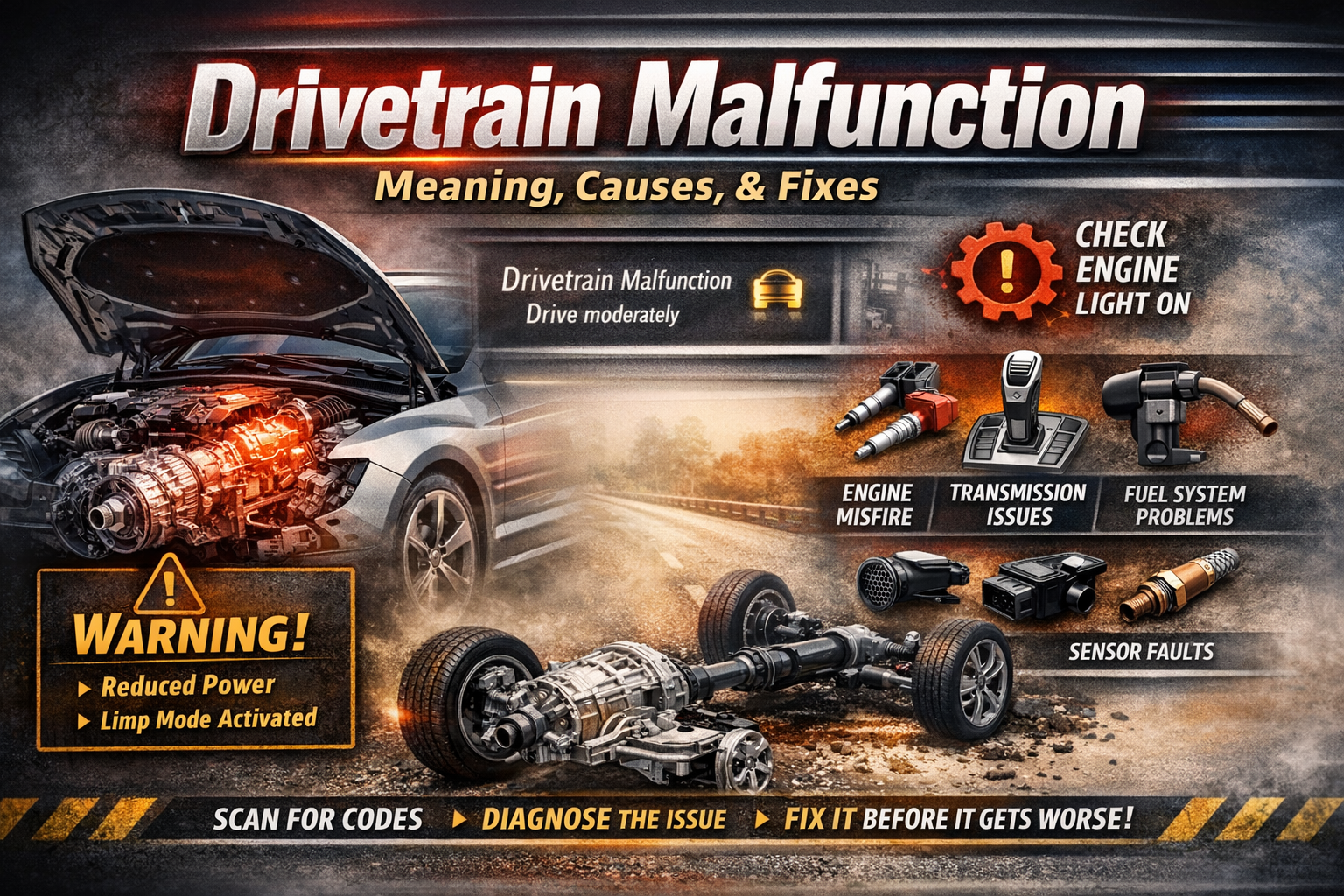
A drivetrain malfunction warning means your vehicle’s computer (ECU/PCM) has detected a problem affecting the system that transfers power from the engine (or motor) to the wheels.
In simple terms:
✅ The engine is making power
❌ Something is preventing that power from reaching the wheels properly
The car detects abnormal performance, readings, or mechanical behavior and triggers a warning to protect the engine, transmission, or driveline components.
Why the Warning Appears
Modern cars are controlled by computers and sensors. When a sensor detects something outside the expected range—like excessive slip, misfires, incorrect boost pressure, abnormal transmission behavior, or traction control conflict—the ECU may display:
- “Drivetrain Malfunction”
- “Drivetrain: Drive Moderately”
- “Reduced Power”
- “Transmission Fault”
- “Powertrain Malfunction”
In many vehicles (especially European makes like BMW, MINI, Audi, Mercedes), the warning may appear even if the car still drives “normally”—at least at first.
What Components Are Part of the Drivetrain?
The drivetrain includes the parts responsible for moving power from the engine to the wheels. The exact layout depends on whether the car is FWD, RWD, AWD, or 4WD.
Common Drivetrain Components
Here’s what is typically included:
- Engine (power source)
- Transmission (gearbox)
- Torque converter (automatic) or clutch (manual)
- Driveshaft (common in RWD/AWD)
- Differential(s)
- Axles / CV joints
- Transfer case (4WD/AWD)
- Wheel hubs & bearings (indirectly connected)
Important Note: “Powertrain” vs “Drivetrain”
People often confuse these terms.
- Powertrain = engine + transmission + drivetrain
- Drivetrain = components that deliver power to wheels
Some manufacturers use “drivetrain malfunction” to describe any powertrain-related fault, even if the root cause is engine-related (like a misfire).
Common Symptoms of a Drivetrain Malfunction
A drivetrain malfunction can feel mild—or severe. The warning is your car’s way of saying: “Something is wrong, and I’m protecting myself.”
Typical Symptoms
You may notice:
- Loss of power / sluggish acceleration
- Car goes into limp mode
- Rough idling or shaking
- Hard shifting or delayed shifting
- Transmission slipping
- Jerking during acceleration
- Burning smell
- Grinding or clunking noises
- Check Engine Light appears
- Traction control light turns on
- Poor fuel economy
- Stalling or misfiring
What Is Limp Mode?
Limp mode (also called “failsafe mode”) is when the ECU limits engine output and sometimes locks the transmission into a single gear to prevent damage.
If your car suddenly feels like it can’t go past 30–50 mph, limp mode is likely active.
Is It Safe to Drive With a Drivetrain Malfunction Warning?
Sometimes yes, but often no. It depends on what caused it.
When You Should Stop Driving Immediately
Pull over and stop if you experience:
- Loud knocking, clunking, grinding
- Severe shaking or misfiring
- Burning smell (especially transmission fluid smell)
- Loss of ability to accelerate safely
- Overheating warning
- Transmission stuck in gear
- Fluid leaking under the vehicle
Driving in these conditions can destroy expensive components quickly.
When You Might Drive Carefully (Short Distance)
If the car drives normally and the warning appears without symptoms, you may be able to drive slowly to a safe location or repair shop.
But even then, you should scan for codes ASAP.
Top Causes of Drivetrain Malfunction (Most Common to Most Serious)
This section is the heart of the guide. Let’s break down the most frequent causes, including symptoms, why they happen, and typical fixes.
1. Engine Misfires (Spark Plugs, Ignition Coils)
One of the #1 causes of drivetrain malfunction warnings is a misfire.
Why It Triggers the Warning
Misfires cause uneven power delivery. The ECU detects crankshaft speed variations and may limit power to protect the catalytic converter and drivetrain.
Symptoms
- Rough idle
- Shaking under load
- Loss of power
- Check engine light blinking
- Poor fuel economy
Common Causes
- Worn spark plugs
- Failed ignition coil
- Oil leaking into spark plug wells
- Incorrect plug gap
- Bad injector (less common)
Fix
- Replace spark plugs (often every 60k–100k miles depending on car)
- Replace ignition coils if failing
- Inspect valve cover gasket for oil leaks
Cost estimate:
- Spark plugs: $100–$400
- Ignition coils: $150–$800 depending on number and brand
2. Fuel System Problems (Fuel Pump, Injectors, Low Pressure)
Fuel delivery issues are another frequent cause.
Why It Triggers Drivetrain Faults
If the engine runs lean (not enough fuel), it can misfire, hesitate, or knock. The ECU may reduce power.
Symptoms
- Hesitation when accelerating
- Hard starts
- Stalling
- Surging
- Poor throttle response
Common Causes
- Weak fuel pump
- Clogged fuel filter (some cars still have them externally)
- Dirty fuel injectors
- Bad fuel pressure regulator
- Low-quality fuel
Fix
- Fuel system cleaning (injector cleaner or professional service)
- Replace fuel pump if pressure is low
- Replace failing injectors
Cost estimate:
- Injector cleaning: $100–$250
- Fuel pump replacement: $400–$1,500
- Injectors: $300–$2,000+
3. Transmission Issues (Slipping, Valve Body, Solenoids)
If the transmission can’t shift properly or is slipping, the car may display drivetrain malfunction warnings.
Symptoms
- RPM rises but car doesn’t accelerate
- Jerky shifting
- Delayed engagement (D or R takes time)
- Harsh gear changes
- Transmission overheating warning
Common Causes
- Low or dirty transmission fluid
- Faulty shift solenoid
- Valve body problems
- Worn clutch packs (automatic)
- Mechatronic issues (common in DSG/DCT transmissions)
Fix
- Check fluid level and condition
- Replace solenoids or valve body if needed
- Transmission service (fluid + filter) where applicable
Cost estimate:
- Transmission fluid service: $150–$500
- Solenoid replacement: $300–$900
- Valve body repair: $800–$2,500
- Transmission rebuild/replacement: $3,000–$8,000+
4. Low Battery Voltage / Charging System Problems
This one surprises many drivers: a weak battery or failing alternator can trigger drivetrain malfunction warnings.
Why It Happens
Modern cars rely heavily on stable voltage. If voltage drops too low, sensors and modules can misbehave.
Symptoms
- Random warnings across dashboard
- Slow cranking or no start
- Flickering lights
- Electronics acting strange
Common Causes
- Old battery (3–6 years)
- Weak alternator
- Loose battery terminals
- Corroded ground straps
Fix
- Battery test and replace if weak
- Alternator test
- Clean terminals and tighten connections
Cost estimate:
- Battery: $150–$350
- Alternator: $400–$1,200
5. Turbocharger / Boost Leak / Charge Pipe Failure
On turbocharged cars, boost-related faults are a major cause of drivetrain malfunction warnings.
Why It Triggers Drivetrain Errors
The ECU expects a certain boost pressure. If it sees underboost or overboost, it may reduce power.
Symptoms
- Sudden power loss
- Whistling or whooshing noise
- Poor acceleration
- Check engine light
- Limp mode
Common Causes
- Boost leak (cracked hose)
- Broken charge pipe (common on some BMW engines)
- Wastegate actuator issues
- Faulty boost pressure sensor
- Turbo failure (worst-case)
Fix
- Smoke test intake system
- Replace cracked hoses/pipes
- Replace boost sensor if faulty
- Turbo replacement if damaged
Cost estimate:
- Hose/pipe repair: $100–$600
- Turbo replacement: $1,200–$4,000+
6. Faulty Sensors (MAF, MAP, O2, Crank, Cam)
Sensors provide the ECU with critical engine data. If one fails, drivetrain warnings may appear.
Common Sensors That Cause Drivetrain Malfunction
- Mass Air Flow (MAF) sensor
- Manifold Absolute Pressure (MAP) sensor
- Oxygen sensors (O2)
- Crankshaft position sensor
- Camshaft position sensor
- Throttle position sensor
- Wheel speed sensors (especially with traction control)
Symptoms
- Rough running
- Poor acceleration
- Random stalling
- Incorrect shifting behavior
- Erratic idle
Fix
- Scan codes
- Replace sensor(s)
- Check wiring and connectors
Cost estimate:
- Sensor replacement: $100–$600 each
7. Throttle Body / Electronic Throttle Control Issues
Many modern vehicles use drive-by-wire throttles, meaning the pedal doesn’t mechanically control the throttle plate.
Symptoms
- Reduced engine power warning
- Hesitation
- Throttle not responding
- Limp mode
Common Causes
- Dirty throttle body
- Failing throttle actuator motor
- Pedal position sensor failure
Fix
- Throttle body cleaning
- Relearn/adaptation procedure
- Replace throttle body if defective
Cost estimate:
- Cleaning: $50–$200
- Replacement: $300–$1,200
8. Drivetrain Mechanical Issues (CV Joints, Axles, Driveshaft)
Sometimes the drivetrain warning really is a mechanical driveline issue.
Symptoms
- Clicking when turning (CV joint)
- Vibration at speed (driveshaft imbalance)
- Clunking when shifting into gear
- Grease leaks near axle boots
Common Causes
- Torn CV boot leading to joint wear
- Bent axle
- Failing U-joints (RWD)
- Differential wear
Fix
- Replace axle/CV joint
- Replace driveshaft components
- Inspect differential fluid and bearings
Cost estimate:
- CV axle: $250–$900
- Driveshaft repair: $500–$1,500
- Differential rebuild: $1,500–$4,000+
9. Overheating (Engine or Transmission)
Heat kills drivetrains. If the car detects overheating, it may reduce power to protect components.
Symptoms
- Temperature warning
- Reduced power
- Coolant smell
- Steam from hood
Causes
- Low coolant
- Bad thermostat
- Failing water pump
- Radiator fan failure
- Transmission cooler issues
Fix
- Stop driving immediately if overheating
- Pressure test cooling system
- Replace failing components
Cost estimate:
- Thermostat: $200–$600
- Water pump: $400–$1,500
- Radiator: $300–$1,200
10. Software / ECU / Module Communication Errors
Modern cars have multiple computers that communicate constantly. If communication fails, drivetrain errors can appear.
Symptoms
- Warning appears randomly
- Multiple systems fail at once
- Warning disappears after restart (temporarily)
Causes
- Software bugs
- Faulty module (TCU, ECU)
- CAN bus wiring issues
- Low voltage causing module dropouts
Fix
- Dealer-level diagnostic scan
- Software update
- Wiring repair
- Module replacement (if required)
Cost estimate:
- Diagnostics: $100–$250
- Software update: $150–$400
- Module replacement: $500–$2,500+
How to Diagnose a Drivetrain Malfunction (Step-by-Step)
The fastest way to stop guessing is to read the diagnostic trouble codes (DTCs).
Step 1: Check the Symptoms
Ask yourself:
- Does the car shake?
- Does it shift harshly?
- Does it hesitate?
- Does it feel like limp mode?
- Did it happen after fueling up?
- Did it happen during hard acceleration?
Your answers help narrow down the system.
Step 2: Scan the Car for Codes (OBD2)
Use an OBD2 scanner (basic or advanced).
Common Code Families Related to Drivetrain Malfunction
- P0300–P0308 → Misfires
- P0171/P0174 → Lean condition
- P0420 → Catalyst efficiency
- P0101 → MAF sensor range/performance
- P0299 → Turbo underboost
- P0700 → Transmission control system malfunction
- P0715 → Input/turbine speed sensor
- P0720 → Output speed sensor
Even if your car is European and needs a more advanced scanner, the idea is the same: codes tell the story.
Step 3: Check Fluids
- Engine oil level and condition
- Coolant level
- Transmission fluid (if applicable and serviceable)
- Differential/transfer case fluids (if symptoms suggest)
Low fluids can trigger warnings or accelerate damage.
Step 4: Inspect for Obvious Issues
Look for:
- Loose intake pipes
- Cracked vacuum lines
- Oil leaks around valve cover
- Battery terminal corrosion
- Broken wiring near sensors
- Leaking axle boots
Step 5: Clear Codes (Only After Fixing)
Clearing codes without fixing the issue is like turning off a smoke alarm while the kitchen is still burning.
However, after repairs, clearing codes helps confirm the fix.
How to Fix a Drivetrain Malfunction (Most Effective Solutions)
Below are the most effective real-world fixes based on what typically triggers drivetrain warnings.
Fix #1: Replace Spark Plugs and Coils
If your car is misfiring, this is often the first real repair.
Best for: rough idle, shaking, misfire codes.
Fix #2: Repair Boost Leaks or Intake Problems
If turbo pressure is wrong, the ECU may force limp mode.
Best for: power loss under acceleration, underboost codes.
Fix #3: Service Transmission Fluid (If Applicable)
Dirty or low fluid can cause slipping and harsh shifting.
Best for: shifting issues, delayed engagement.
Fix #4: Replace Weak Battery / Repair Charging System
Electrical stability is crucial.
Best for: random warnings, slow starts, multiple lights.
Fix #5: Replace Faulty Sensors
Sensors fail more often than major mechanical components.
Best for: inconsistent performance, sensor-related codes.
Fix #6: Software Updates / Module Reset
Sometimes the fix is digital, not mechanical.
Best for: intermittent warnings with no symptoms.
Drivetrain Malfunction Repair Cost (Realistic Breakdown)
Here’s a practical cost guide:
Minor Repairs ($100–$500)
- Spark plugs
- Basic sensors
- Battery replacement
- Throttle body cleaning
- Vacuum/boost hose repair
Medium Repairs ($500–$2,000)
- Ignition coils (multiple)
- Fuel pump replacement
- Injector replacement
- Transmission solenoids
- Water pump / thermostat
Major Repairs ($2,000–$8,000+)
- Turbo replacement
- Transmission rebuild
- Differential rebuild
- Transfer case replacement
- ECU/module replacement
The biggest cost factor is whether the issue is:
✅ A wearable maintenance part
❌ A core drivetrain component (transmission/differential)
Drivetrain Malfunction FAQ (Highly Searched Questions)
What does drivetrain malfunction mean on BMW?
On BMW models, “Drivetrain Malfunction” often appears due to:
- ignition coil failure
- spark plugs
- boost leak / charge pipe crack
- high-pressure fuel pump issues
- sensor faults
- transmission adaptation issues
BMWs are sensitive and will trigger warnings quickly to protect the system.
Can low oil cause drivetrain malfunction?
Yes. Low oil can cause timing issues, VANOS problems, overheating, or engine protection mode. Some cars reduce power when oil pressure is abnormal.
Can I reset drivetrain malfunction?
You can clear codes, but resetting without fixing the cause is temporary. The warning will return if the problem persists.
Does drivetrain malfunction mean transmission failure?
Not always. It can be:
- misfire
- sensor issue
- turbo boost fault
- fuel delivery problem
But it can be transmission-related—especially if shifting symptoms exist.
Why does the warning come and go?
Intermittent drivetrain warnings often come from:
- weak battery voltage
- failing ignition coil
- loose intake pipe
- heat-related sensor failures
- software glitches
How to Prevent Drivetrain Malfunctions (Pro Tips)
Prevention is always cheaper than repairs. Here are practical steps that reduce the chance of drivetrain warnings:
1. Follow Maintenance Intervals
- Change engine oil on time
- Replace spark plugs at recommended mileage
- Replace air filters regularly
2. Don’t Ignore Small Symptoms
A slight hesitation today can become limp mode tomorrow.
3. Use Quality Fuel
Cheap fuel can contribute to knock, injector deposits, and misfires—especially in turbo engines.
4. Let the Car Warm Up (Especially Turbo Engines)
Hard acceleration on a cold engine increases wear and stress.
5. Fix Small Leaks Early
Oil leaks into ignition coil wells can trigger misfires and drivetrain warnings.
6. Keep Battery and Charging System Healthy
Modern vehicles depend on stable voltage. Replace batteries before they fail completely.
7. Scan Codes Early
An OBD2 scanner can save you hundreds by catching issues early.
Final Thoughts: What to Do When You See “Drivetrain Malfunction”
If your dashboard shows a drivetrain malfunction warning, don’t panic—but don’t ignore it either.
The Smart Action Plan
- Drive gently and avoid hard acceleration
- Check for overheating or severe symptoms
- Scan the vehicle for diagnostic codes
- Fix the root cause (don’t just reset)
- Test drive and confirm the warning is gone
In many cases, the fix is straightforward—like spark plugs, coils, sensors, or a boost leak. But the sooner you act, the more likely you’ll avoid expensive drivetrain damage.