

Table of Contents
Introduction
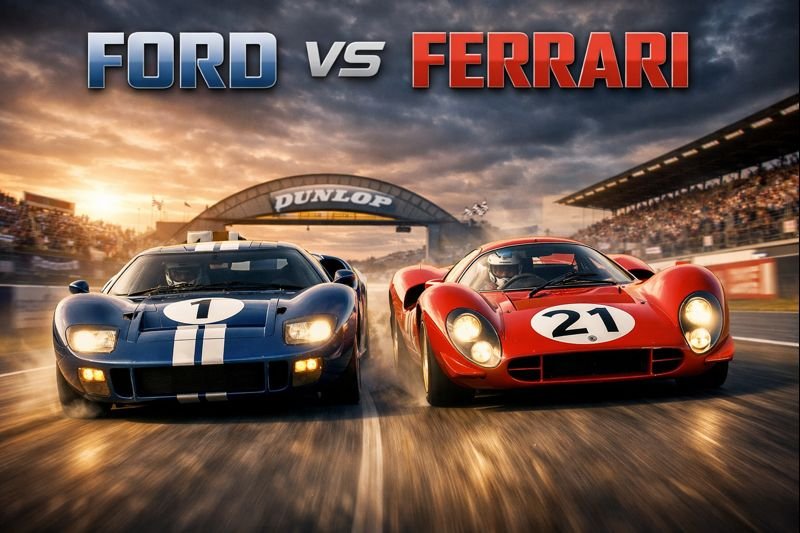
Few rivalries in automotive history are as legendary, dramatic, and influential as Ford vs Ferrari. What began in the early 1960s as a failed business deal quickly escalated into a full-scale engineering war that forever changed motorsports, automotive design, and brand identity. This rivalry was not just about speed; it was about pride, innovation, corporate philosophy, and the relentless pursuit of victory on the world’s most demanding stage: the 24 Hours of Le Mans.
- Table of Contents
- Introduction
- Historical Background: How the Rivalry Began
- Engineering Philosophy: Two Opposite Worlds
- The Machines: Iconic Cars of the Rivalry
- Performance at Le Mans: The Turning Point
- Engineering Innovations Born from the Rivalry
- Brand Impact and Marketing Power
- Cultural Legacy of Ford vs Ferrari
- Ford vs Ferrari Today: A Lasting Influence
- Conclusion
In this in-depth analysis, we explore Ford vs Ferrari through three critical lenses: engineering, performance, and legacy. We will examine how two radically different companies—an American mass-production giant and an Italian boutique racing brand—approached car design, endurance racing, and technological innovation. By the end of this article, you’ll understand why this rivalry still resonates today and how it continues to shape the modern automotive world.
Historical Background: How the Rivalry Began
Ferrari’s Early Dominance
By the late 1950s and early 1960s, Ferrari was the undisputed king of endurance racing. Under the leadership of Enzo Ferrari, the brand dominated Le Mans, winning multiple times with cars that combined lightweight construction, high-revving engines, and race-focused engineering. Ferrari’s philosophy was simple: racing came first, and road cars existed mainly to fund competition.
Ferrari’s success wasn’t just technical—it was emotional. The brand represented passion, artistry, and European racing heritage. Victories at Le Mans reinforced Ferrari’s image as the pinnacle of motorsport excellence.
Ford’s Failed Acquisition Attempt
In 1963, Ford Motor Company attempted to purchase Ferrari. Henry Ford II saw racing as a powerful marketing tool and believed Ferrari’s prestige could elevate Ford’s global image. After months of negotiations, the deal collapsed at the last moment when Enzo Ferrari refused to give up control of the racing program.
This rejection ignited what would become one of the most famous rivalries in motorsport history. Henry Ford II reportedly issued a clear directive: beat Ferrari at Le Mans—no matter the cost.
Engineering Philosophy: Two Opposite Worlds
Ferrari’s Engineering Approach
Ferrari’s engineering philosophy was rooted in precision, balance, and racing purity. Key characteristics included:
- Lightweight tubular chassis designs
- Naturally aspirated V12 engines
- Rear- and mid-engine layouts for optimal balance
- Emphasis on driver feedback and mechanical simplicity
Ferrari engineers focused on refining proven concepts rather than radical reinvention. Each iteration was an evolution, not a revolution. The cars were demanding but rewarding, designed for skilled drivers who could extract their full potential.
Ford’s Engineering Strategy
Ford approached the challenge very differently. Instead of relying solely on internal expertise, Ford assembled an international dream team:
- Carroll Shelby for performance development
- Lola Cars for chassis engineering
- Advanced wind tunnel testing and durability analysis
The result was the Ford GT40, a car engineered with brute force, durability, and scalability in mind. Ford emphasized:
- Large-displacement V8 engines
- Extensive testing and data-driven development
- Reliability over elegance
- Corporate-level funding and resources
Unlike Ferrari’s artisanal approach, Ford treated Le Mans as a massive industrial project.
The Machines: Iconic Cars of the Rivalry
Ferrari 250 Series
Ferrari’s primary weapons during this era were the 250 Testa Rossa and 250 GTO. These cars featured:
- 3.0-liter V12 engines
- Lightweight aluminum bodies
- Exceptional handling
- Proven endurance reliability
The Ferrari 250 GTO, in particular, has since become one of the most valuable cars in the world, symbolizing Ferrari’s racing heritage.
Ford GT40
The Ford GT40 was designed specifically to defeat Ferrari at Le Mans. Its defining features included:
- A low-profile design (40 inches tall)
- Mid-mounted V8 engines (4.7L to 7.0L)
- Advanced aerodynamics for its time
- Exceptional straight-line speed
The GT40 evolved rapidly, with later versions prioritizing stability, cooling, and durability for 24-hour racing conditions.
Performance at Le Mans: The Turning Point
Early Struggles for Ford
Ford’s first attempts at Le Mans were difficult. Early GT40s suffered from mechanical failures, overheating, and handling issues. Ferrari, meanwhile, continued to dominate using refined and reliable machines.
These setbacks forced Ford to rethink its approach, investing even more heavily in testing, driver development, and engineering refinement.
1966: Ford’s Historic Victory
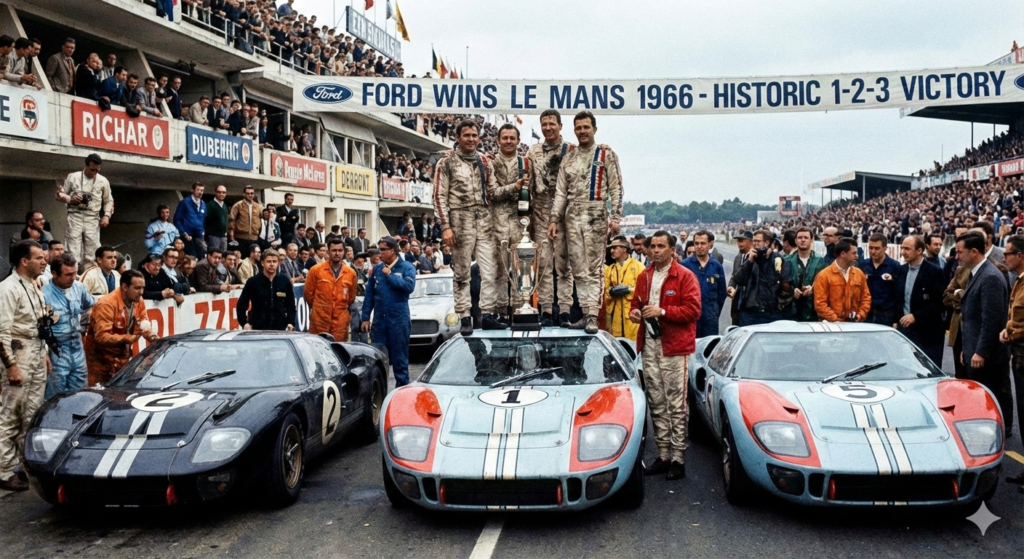
The rivalry reached its climax in 1966, when Ford achieved one of the most decisive victories in motorsport history. Ford GT40s finished 1st, 2nd, and 3rd at Le Mans, ending Ferrari’s dominance.
This victory was not just symbolic—it demonstrated the power of:
- Systematic engineering
- Large-scale resources
- Endurance-focused design
Ford would go on to win Le Mans four consecutive times (1966–1969).
Engineering Innovations Born from the Rivalry
Advancements from Ferrari
Ferrari’s contributions during this period influenced generations of sports cars:
- Improved V12 efficiency
- Lightweight construction techniques
- Aerodynamic body shaping
- Racing-derived suspension geometry
Many of these innovations found their way into Ferrari’s road cars, strengthening the brand’s identity.
Advancements from Ford
Ford’s Le Mans program accelerated innovation in:
- Wind tunnel testing
- High-speed aerodynamics
- Brake cooling systems
- Engine durability under extreme conditions
The GT40 program also demonstrated how racing technology could influence mass-market vehicles, shaping Ford’s performance divisions.
Brand Impact and Marketing Power
Ferrari’s Enduring Prestige
Despite losing Le Mans dominance, Ferrari emerged with its mystique intact. The rivalry reinforced Ferrari’s image as:
- A passionate, racing-first brand
- A symbol of exclusivity and craftsmanship
- A company driven by emotion rather than corporate strategy
Ferrari continues to leverage its racing heritage as a core pillar of its brand identity.
Ford’s Transformation
For Ford, beating Ferrari was transformative. It proved that an American manufacturer could dominate European endurance racing. The victory:
- Elevated Ford’s global image
- Gave credibility to its performance vehicles
- Laid the foundation for future icons like the Mustang and modern Ford GT
Cultural Legacy of Ford vs Ferrari
Influence on Modern Motorsports
The Ford vs Ferrari rivalry set new standards for:
- Manufacturer-backed racing programs
- Engineering collaboration across continents
- Data-driven development strategies
Modern endurance racing owes much of its structure to lessons learned during this era.
Popular Culture and Media
The story has inspired books, documentaries, and the popular film Ford v Ferrari (also known as Le Mans ’66). These portrayals highlight the human drama behind the machines—engineers, drivers, and executives locked in a battle of wills.
Ford vs Ferrari Today: A Lasting Influence
Modern Interpretations
- The modern Ford GT pays direct homage to the GT40, incorporating advanced aerodynamics and carbon fiber construction.
- Ferrari continues to dominate global motorsport, particularly in Formula 1 and GT racing, with technology rooted in its endurance racing past.
Lessons for the Automotive Industry
The rivalry teaches timeless lessons:
- Innovation thrives under competition
- Engineering excellence requires both creativity and resources
- Racing success can define brand identity for decades
Conclusion
Ford vs Ferrari is far more than a historic racing rivalry—it is a defining chapter in automotive history. It represents the clash of two philosophies: American industrial power versus Italian racing artistry. Through engineering innovation, relentless performance development, and unforgettable competition, both brands emerged stronger.
Ferrari maintained its soul and prestige, while Ford proved that determination and engineering discipline could conquer even the most established dominance. Together, they reshaped motorsport and left a legacy that continues to inspire engineers, racers, and enthusiasts worldwide.
Decades later, the echoes of Ford vs Ferrari still roar across racetracks and highways, reminding us that true progress is often born from rivalry.