



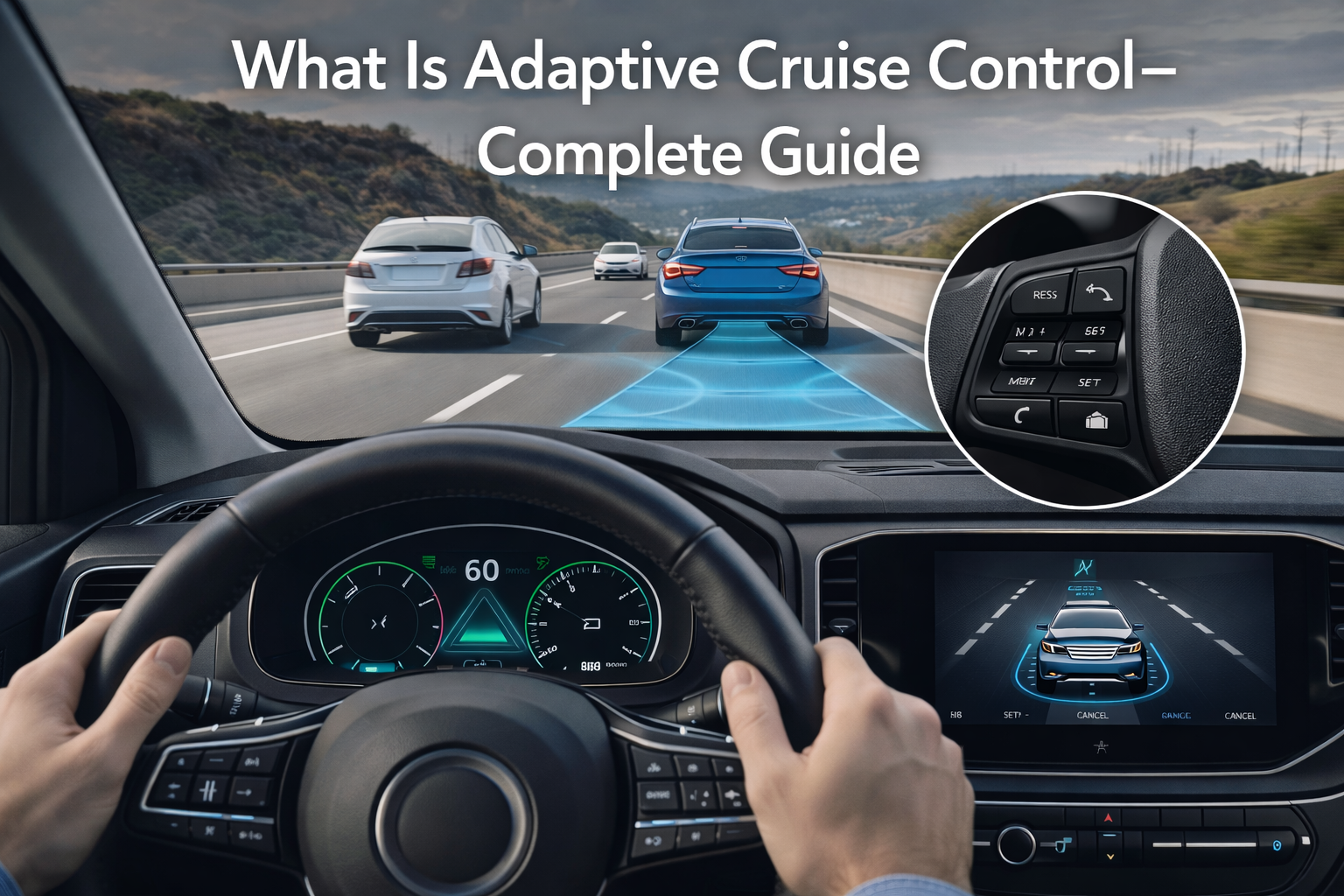
Adaptive Cruise Control (ACC) is one of the most important driver-assistance technologies in modern vehicles. It not only maintains your speed like traditional cruise control but also automatically adjusts your car’s speed to keep a safe distance from the vehicle in front of you.
- What Is Adaptive Cruise Control?
- How Does Adaptive Cruise Control Work?
- Adaptive Cruise Control vs Regular Cruise Control
- What Are the Main Benefits of Adaptive Cruise Control?
- Is Adaptive Cruise Control Safe?
- Can Adaptive Cruise Control Stop the Car?
- What Cars Have Adaptive Cruise Control?
- How Much Does Adaptive Cruise Control Cost?
- Does Adaptive Cruise Control Save Gas?
- Common Problems With Adaptive Cruise Control
- Can Adaptive Cruise Control Be Turned Off?
- Is Adaptive Cruise Control Worth It?
- Final Thoughts
If you have ever driven on a highway, in traffic, or on long road trips, Adaptive Cruise Control can dramatically reduce fatigue, improve safety, and make driving more comfortable. In this complete guide, we will explain how ACC works, its benefits, limitations, cost, safety impact, and whether it is worth it for your car.
What Is Adaptive Cruise Control?
Adaptive Cruise Control is an advanced driver-assistance system (ADAS) that automatically controls your vehicle’s speed to maintain a preset distance from the car ahead.
Unlike standard cruise control, which only keeps your car at a fixed speed, ACC can:
- Slow your car down when traffic slows
- Speed up when the road clears
- Maintain a safe following distance automatically
- In some vehicles, bring the car to a full stop and resume
This makes ACC extremely useful for highway driving, heavy traffic, and long commutes.
How Does Adaptive Cruise Control Work?
Adaptive Cruise Control uses a combination of:
- Radar sensors
- Cameras
- Electronic control units (ECUs)
These sensors are usually located behind the front grille or windshield.
Step-by-step operation:
- You set a cruising speed (for example, 100 km/h).
- You choose a following distance (close, medium, or far).
- The radar scans the road ahead.
- If a slower car enters your lane, ACC reduces your speed automatically.
- When the road clears, ACC returns you to your set speed.
In advanced systems, ACC can even work in stop-and-go traffic, braking your car down to zero and restarting automatically.
Adaptive Cruise Control vs Regular Cruise Control
| Feature | Regular Cruise Control | Adaptive Cruise Control |
|---|---|---|
| Maintains speed | Yes | Yes |
| Detects traffic | No | Yes |
| Adjusts speed | No | Yes |
| Maintains distance | No | Yes |
| Stops the car | No | Some models |
| Reduces collisions | No | Yes |
Traditional cruise control is outdated compared to ACC. With traffic getting heavier, Adaptive Cruise Control is far safer and more convenient.

What Are the Main Benefits of Adaptive Cruise Control?
1️⃣ Improved Safety
ACC helps prevent rear-end collisions by automatically slowing down when traffic slows.
2️⃣ Less Driver Fatigue
Long highway drives become much easier because the system controls speed and braking.
3️⃣ Better Fuel Efficiency
ACC maintains smoother speed changes, which reduces fuel waste caused by sudden braking and acceleration.
4️⃣ Stress-Free Driving
Stop-and-go traffic becomes more comfortable with ACC, especially in cities and on crowded highways.
Is Adaptive Cruise Control Safe?
Yes — but it is not autonomous driving.
ACC is a driver-assistance system, meaning:
- You must keep your hands on the wheel
- You must watch the road
- You must be ready to brake or steer
ACC reduces accidents, but it does not replace the driver.
Can Adaptive Cruise Control Stop the Car?
Yes, many modern systems support full-speed-range ACC. This means:
- It can slow down
- Stop the car completely
- Resume when traffic moves
However, some older ACC systems only work above 30–40 km/h.
What Cars Have Adaptive Cruise Control?
Today, most mid-range and luxury vehicles offer ACC, including:
- Toyota
- Honda
- Hyundai
- Kia
- Ford
- BMW
- Mercedes
- Audi
- Volkswagen
- Tesla
In many cars, ACC is standard. In others, it is part of a safety package.
How Much Does Adaptive Cruise Control Cost?
If it is not standard, ACC usually costs:
- $500 to $2,500 as an option
- More if bundled with lane assist and collision avoidance
Retrofitting ACC is very expensive and usually not recommended because it requires radar, cameras, and ECU coding.
Does Adaptive Cruise Control Save Gas?
Yes, in many situations.
ACC avoids:
- Hard acceleration
- Sudden braking
This leads to smoother driving, which improves fuel economy by 5–10% on highways.
Common Problems With Adaptive Cruise Control
Even though ACC is reliable, it can experience issues such as:
- Radar blocked by dirt or snow
- Camera misalignment
- Software errors
- False braking
- Inconsistent distance control
Regular sensor cleaning and calibration after accidents is important.
Can Adaptive Cruise Control Be Turned Off?
Yes. You can:
- Disable ACC
- Switch back to standard cruise control
- Or drive manually
This gives you full control whenever you want.
Is Adaptive Cruise Control Worth It?
If you:
- Drive on highways
- Commute in traffic
- Take long trips
Then yes — Adaptive Cruise Control is one of the best safety and comfort upgrades you can have.
Final Thoughts
Adaptive Cruise Control is no longer a luxury — it is becoming a standard safety feature. It makes driving safer, smoother, and far less stressful.
Whether you own a family SUV, a daily commuter, or a luxury car, ACC is one of the smartest automotive technologies available today.