
Table of Contents
⚙️ Introduction
When it comes to choosing the right motor oil, even small differences in viscosity can have a big impact on your engine’s performance, efficiency, and lifespan. Two of the most common options are 5W20 and 5W30 — but what exactly sets them apart?
- Table of Contents
- ⚙️ Introduction
- 🧩 1. Understanding Oil Grades: What Do 5W20 and 5W30 Mean?
- 🌡️ 2. Viscosity Difference in Real Conditions
- 🚗 3. Fuel Economy Comparison
- 🧱 4. Engine Protection and Performance
- 📘 5. Manufacturer Recommendations
- ⚖️ 6. Quick Comparison Table: 5W20 vs 5W30
- 🧠 7. Can You Mix 5W20 and 5W30?
- 🏁 Conclusion
- ❓ FAQ: 5W20 vs 5W30
In this detailed guide, OnlyMechanic.com explains the key differences between 5W20 vs 5W30, their pros and cons, and which one is best suited for your vehicle and driving conditions.
🧩 1. Understanding Oil Grades: What Do 5W20 and 5W30 Mean?
Motor oils are graded by the Society of Automotive Engineers (SAE) based on viscosity, which measures how thick or thin the oil is at different temperatures.
Here’s what the numbers mean:
- “5W” – The “W” stands for Winter, and the number before it (5) shows the oil’s viscosity at cold temperatures. Both 5W20 and 5W30 flow easily in cold conditions.
- “20” or “30” – The second number indicates the oil’s viscosity when the engine is fully warmed up (100°C).
✅ Key takeaway:
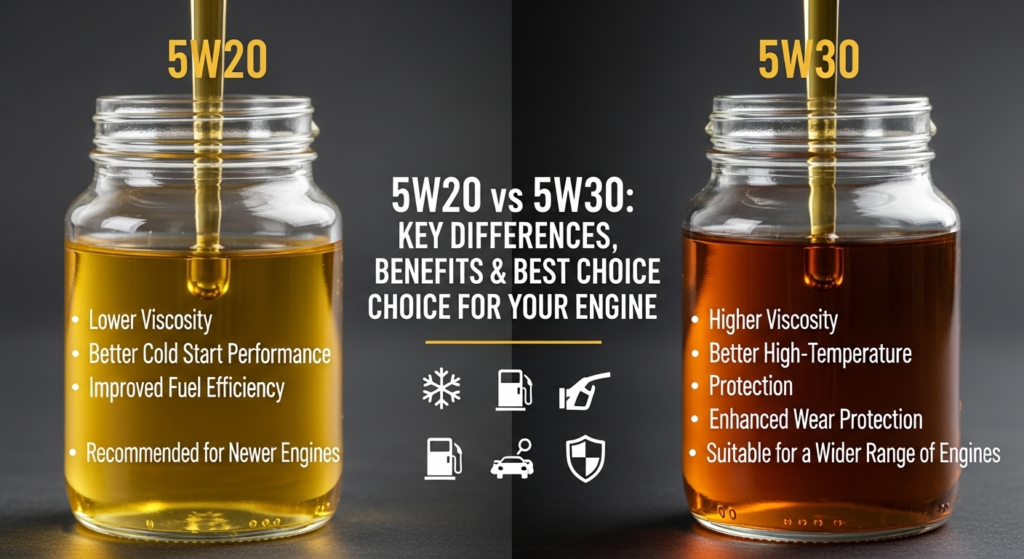
Both oils perform well in cold starts, but 5W20 is thinner at high temperatures, while 5W30 is slightly thicker, offering more protection under stress.
🌡️ 2. Viscosity Difference in Real Conditions
The main difference between 5W20 vs 5W30 lies in how they behave once the engine reaches operating temperature.
🔧 5W20:
- Thinner oil film at high temps
- Reduces internal friction
- Improves fuel efficiency
- Better for modern engines with tight tolerances
🔧 5W30:
- Thicker at high temps
- Provides better protection under heavy loads or high heat
- Ideal for older engines or hot climates
✅ Verdict:
If your car operates mostly in cold or moderate climates, 5W20 is a smart choice.
For hot regions or heavy driving, 5W30 offers better durability.
🚗 3. Fuel Economy Comparison
Fuel economy is one of the biggest reasons automakers recommend 5W20 oil.
Because it’s thinner at high temperatures, it reduces drag inside the engine — allowing it to run more efficiently.
💡 Fuel Efficiency:
- 5W20: Slightly better fuel economy (up to 2%)
- 5W30: Slightly less efficient, but better engine protection under load
✅ Verdict:
If maximizing miles per gallon (MPG) is your priority, 5W20 wins this category.
🧱 4. Engine Protection and Performance
While thinner oils improve efficiency, thicker oils like 5W30 can provide a stronger lubrication barrier under extreme pressure.
⚙️ When to Use 5W20:
- Light-duty engines
- Normal driving conditions
- Cooler climates
⚙️ When to Use 5W30:
- Towing, hauling, or high-performance vehicles
- Hotter climates
- Older engines with more wear
✅ Verdict:
Use 5W20 for efficiency and smooth performance.
Choose 5W30 for protection in demanding or high-temperature situations.
📘 5. Manufacturer Recommendations
Always refer to your vehicle’s owner’s manual before switching oil viscosity.
Most Ford, Honda, and Toyota models built after 2000 recommend 5W20, while some European or older American vehicles specify 5W30.
Using an oil that’s too thick or too thin can:
- Affect oil pressure
- Reduce fuel efficiency
- Increase engine wear over time
✅ Verdict:
Stick to the manufacturer’s recommended oil, but if both are allowed, base your choice on climate and driving conditions.
⚖️ 6. Quick Comparison Table: 5W20 vs 5W30
| Feature | 5W20 | 5W30 |
|---|---|---|
| Cold Weather Performance | Excellent | Excellent |
| Hot Temperature Protection | Good | Excellent |
| Fuel Efficiency | Higher | Moderate |
| Ideal Climate | Cold to moderate | Warm to hot |
| Best For | Modern cars, fuel efficiency | Heavy-duty, hot weather |
| Viscosity at High Temp | Thinner | Thicker |
✅ Summary:
- Choose 5W20 for efficiency and everyday commuting.
- Choose 5W30 for heat resistance and engine protection.
🧠 7. Can You Mix 5W20 and 5W30?
While it’s technically possible, mixing oil viscosities is not recommended. It can create unpredictable results in viscosity and performance. Always use one type consistently to maintain optimal engine protection.
🏁 Conclusion
When comparing 5W20 vs 5W30, both are excellent multigrade oils — but they serve different purposes.
- 5W20: Ideal for newer engines, cooler climates, and drivers seeking fuel efficiency.
- 5W30: Better for older engines, hot regions, or heavy-duty conditions.
👉 Always follow your manufacturer’s guidelines, and consider your driving style and climate before making the switch.
A simple choice of oil can make a major difference in your engine’s health, performance, and longevity.
❓ FAQ: 5W20 vs 5W30
Q1: Can I use 5W30 instead of 5W20?
Yes — if your vehicle’s manual allows both. However, it might slightly reduce fuel economy.
Q2: What happens if I use 5W30 instead of 5W20?
You’ll get better protection but possibly less efficiency, especially in colder weather.
Q3: Which oil lasts longer?
Both can last similar intervals, but 5W30 tends to maintain stability better under heat and stress.
Q4: Is 5W20 synthetic or conventional?
Both 5W20 and 5W30 come in conventional, semi-synthetic, and full synthetic forms.