





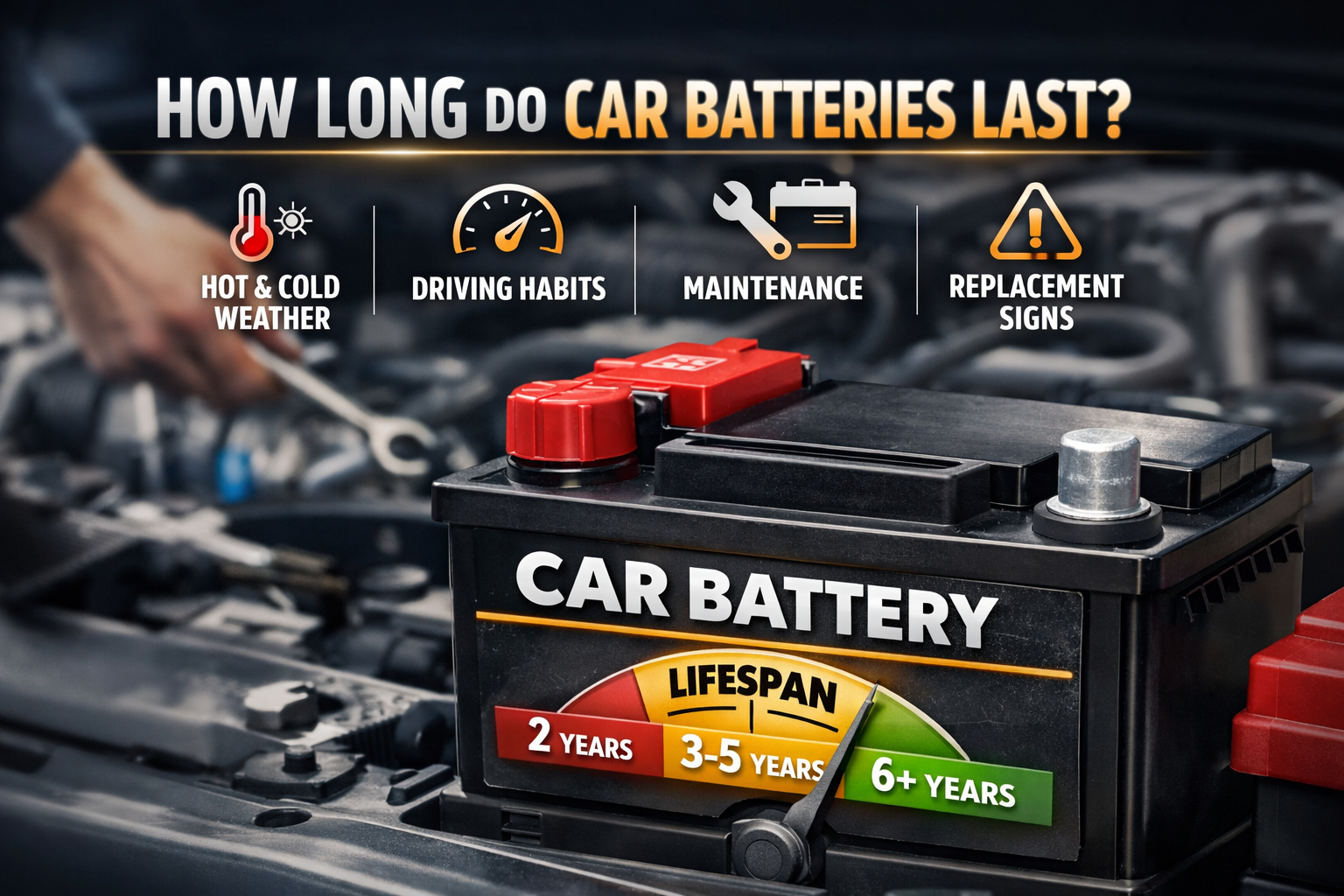
Car batteries are one of the most essential parts of your vehicle. Without a healthy battery, your engine won’t start, your electronics won’t work, and you could end up stranded. But how long do car batteries actually last, and what affects their lifespan?
- Table of Contents
- How Long Do Car Batteries Last on Average?
- What Affects Car Battery Lifespan?
- Signs Your Car Battery Is Dying
- How to Check Your Battery Health
- How to Make Your Car Battery Last Longer
- When Should You Replace a Car Battery?
- How Much Does a Car Battery Cost?
- TIER 1: Premium/Industry Leading (Excellent Lifespan & Innovation)
- TIER 2: High Quality (Reliable & Durable)
- TIER 3: Good/Mainstream (Solid Performance for Price)
- TIER 4: Average/Budget (Acceptable with Limitations)
- TIER 5: Low End/Avoid (Poor Performance & Reliability)
- Key Classification Metrics:
- Special Category (Unranked Premium):
- Important Caveats:
- Final Verdict: How Long Do Car Batteries Last?
- Frequently Asked Questions (FAQ)
In this detailed guide, you’ll learn
Table of Contents
How Long Do Car Batteries Last on Average?
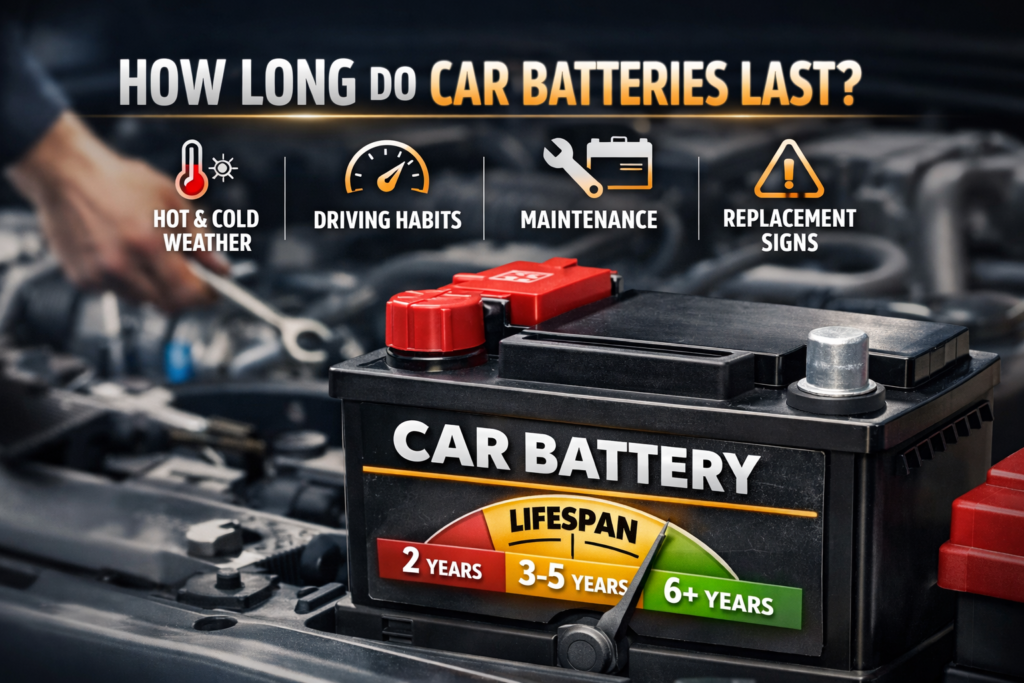
Most car batteries last between 3 to 5 years.
However, this depends on driving conditions, battery quality, weather, and maintenance. Some batteries can last up to 6 years, while others die in as little as 2 years if neglected.
Quick Breakdown:
- Normal conditions: 4–5 years
- Hot climates: 2–3 years
- Cold climates: 3–4 years
- Well-maintained battery: Up to 6 years
What Affects Car Battery Lifespan?
Several factors determine how long your battery will last.
1️⃣ Weather & Temperature
Heat is the biggest battery killer.
- Hot climates cause battery fluid to evaporate faster.
- Cold climates make it harder for the engine to start, putting more strain on the battery.
2️⃣ Driving Habits
Short trips don’t allow your alternator to recharge the battery fully.
Frequent stop-and-start city driving also drains it faster.
3️⃣ Battery Quality
Cheap batteries → shorter life
Premium batteries → better performance and longer lifespan
4️⃣ Electrical Load
Modern cars have high power demands:
- Infotainment screens
- AC
- Heated seats
- Dash cams
- Phone chargers
More electrical usage = more battery strain.
5️⃣ Maintenance
Poor maintenance = shorter life
Regular checkups help prevent early failure.
Signs Your Car Battery Is Dying
Don’t wait until your car refuses to start. Watch for these warning signs:
- 🚗 Engine cranks slowly
- 🔋 Battery warning light on dashboard
- 💡 Dim headlights or weak electronics
- 📻 Radio resets or flickers
- ❄️ Car struggles to start in cold weather
- 🧯 Swollen or leaking battery case
- 🗓️ Battery older than 3 years
If you notice 2 or more of these symptoms, your battery is near the end of its life.
How to Check Your Battery Health
You can test your battery in the following ways:
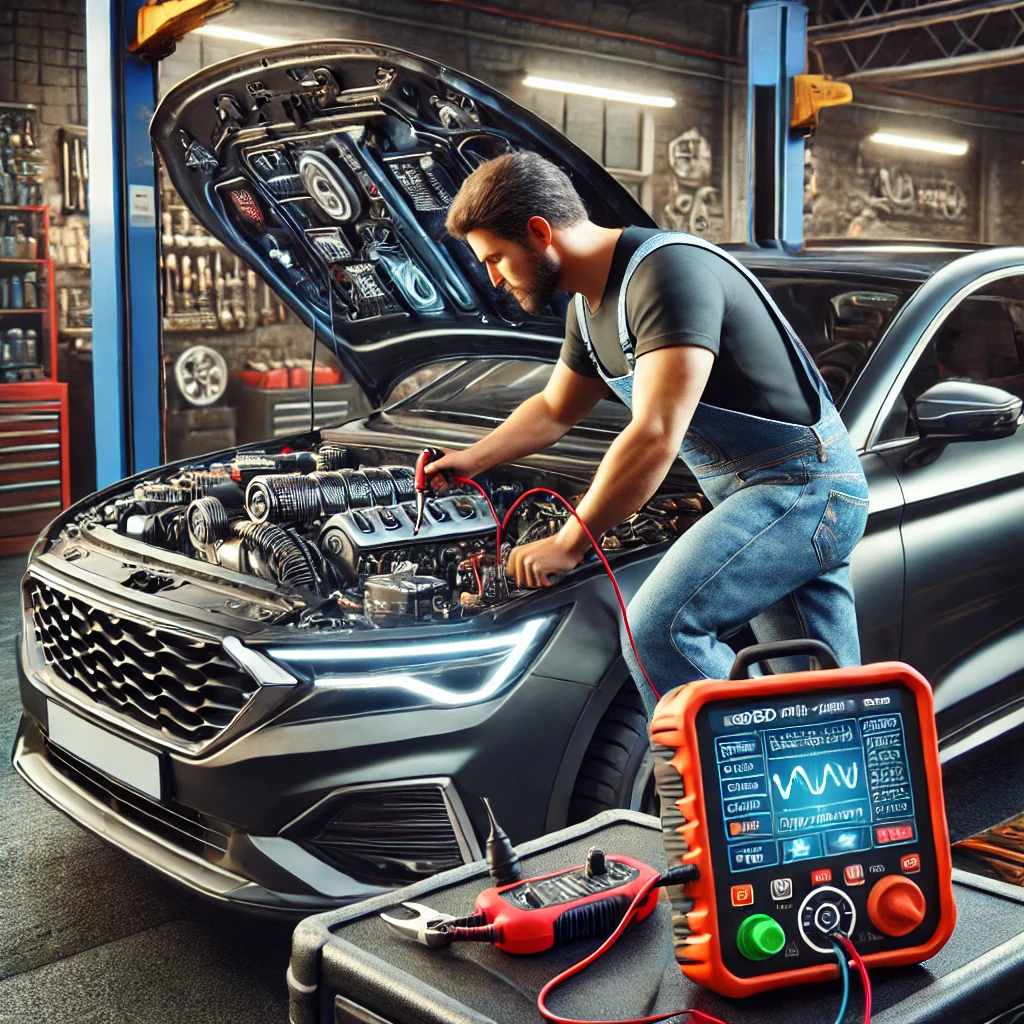
✔️ Multimeter Test
Healthy battery reading:
- 12.6 volts or higher = Good
- 12.4–12.5 volts = Weak
- Below 12.4 volts = Replace soon
✔️ Visit a Mechanic
Most auto shops offer:
- Battery load testing
- Charging system inspection
- Free battery health reports
How to Make Your Car Battery Last Longer
Follow these tips to extend battery life:
- 🔌 Turn off lights & electronics before shutting off the car
- 🚗 Drive regularly (avoid long inactivity)
- 🧼 Keep battery terminals clean
- 🛠️ Check alternator performance
- ❄️ Park in garage during extreme weather
- 🔋 Invest in a quality battery
If you don’t drive often, consider using a battery maintainer.
When Should You Replace a Car Battery?
Replace your battery when:
- It’s 3–5 years old
- Fails battery test
- Shows physical damage
- Frequently needs a jump-start
Waiting too long risks breakdowns.
How Much Does a Car Battery Cost?
Battery cost depends on vehicle type and battery quality.
- Standard battery: $80–$150
- Premium / AGM battery: $150–$300
- Luxury / Start-Stop cars: $250+
Installation may cost extra unless you do it yourself.
Comparaison Table for Batteries brands
TIER 1: Premium/Industry Leading (Excellent Lifespan & Innovation)
| Rank | Brand | Primary Chemistry | Key Strengths | Typical Lifespan | Best For | Weaknesses |
|---|---|---|---|---|---|---|
| 1 | Tesla | NCA/NCM 2170/4680 | Best energy density, superior thermal mgmt, OTA updates | 1,500-2,000 cycles (EV), 15+ years | EVs, home energy storage | Premium pricing, proprietary ecosystem |
| 2 | CATL | LFP/Na-ion/Quantal | Industry-leading cycle life, extreme safety, cost-effective | 3,000-6,000+ cycles (LFP) | Mass-market EVs, grid storage | Less energy dense than NMC |
| 3 | LG Energy Solution | NCM 712/811 | Fast charging, high energy density, global supply | 1,800-2,500 cycles | EVs, premium electronics | Past recall issues, thermal sensitivity |
| 4 | Samsung SDI | Gen5 NCA/NCM | Stable chemistry, prismatic innovation, safety focus | 1,500-2,000 cycles | EVs, IT devices | Conservative energy density |
TIER 2: High Quality (Reliable & Durable)
| Rank | Brand | Primary Chemistry | Key Strengths | Typical Lifespan | Best For | Weaknesses |
|---|---|---|---|---|---|---|
| 5 | BYD | Blade LFP | Exceptional safety, structural design, vertical integration | 3,000-5,000 cycles | EVs, buses, energy storage | Weight penalty, Chinese brand stigma |
| 6 | Panasonic | NCR18650/21700 | Proven reliability, consistent quality, Tesla partnership | 500-800 cycles (consumer) | Consumer electronics, EVs | Conservative innovation, premium pricing |
| 7 | Enphase | LiFePO4 (IQ) | Modular design, excellent warranty, solar integration | 4,000-6,000 cycles | Home solar storage | Very expensive, proprietary system |
| 8 | Sony | Li-ion (VTC) | High-drain performance, consistent quality | 300-500 cycles | High-performance electronics | Limited market presence recently |
TIER 3: Good/Mainstream (Solid Performance for Price)
| Rank | Brand | Primary Chemistry | Key Strengths | Typical Lifespan | Best For | Weaknesses |
|---|---|---|---|---|---|---|
| 9 | Duracell | Alkaline/Optimum/Li-ion | Trusted brand, leak protection, wide availability | 10y shelf (alkaline), 400 cycles (rechargeable) | Household devices, toys | Expensive for alkaline, mixed quality in rechargeables |
| 10 | Energizer | Alkaline/Lithium Ultimate | Extreme temps performance, long shelf life | 20y shelf (lithium), 300 cycles (rechargeable) | Critical devices, outdoor use | Premium pricing, inconsistent rechargeable quality |
| 11 | Anker | Li-ion/LiFePO4 | Value-focused, good consumer electronics | 800-1,000 cycles (power banks) | Power banks, charging gear | Not for high-drain applications |
| 12 | A123 Systems | Nanophosphate LFP | High power density, extreme cycle life | 2,000-3,000 cycles | Power tools, racing, industrial | Niche focus, less energy dense |
TIER 4: Average/Budget (Acceptable with Limitations)
| Rank | Brand | Primary Chemistry | Key Strengths | Typical Lifespan | Best For | Weaknesses |
|---|---|---|---|---|---|---|
| 13 | Rayovac | Alkaline/Heavy Duty | Low cost, decent performance | 5-7y shelf, 100 cycles (rechargeable) | Low-drain devices | Higher leakage risk, inconsistent batches |
| 14 | Amazon Basics | Alkaline (FDK made) | Extreme value, surprisingly capable | 5-10y shelf | Disposable applications | No innovation, questionable long-term reliability |
| 15 | Tenergy | NiMH/Li-ion | Budget rechargeables, specialty formats | 200-500 cycles | Hobbyists, budget-conscious | Inconsistent quality control |
| 16 | EBL | Li-ion/NiMH | Good variety, affordable multipacks | 300-800 cycles (varies widely) | General consumer use | Quality varies by product line |
TIER 5: Low End/Avoid (Poor Performance & Reliability)
| Rank | Brand | Primary Chemistry | Key Strengths | Typical Lifespan | Best For | Weaknesses |
|---|---|---|---|---|---|---|
| 17 | Generic/No-Name | Various (often low-grade) | Extremely cheap | 50-200 cycles, high failure rate | Disposable use only | Safety risks, environmental damage |
| 18 | Ultralast | Alkaline/Zinc-carbon | Available everywhere | 1-3y shelf, very limited power | Emergency use only | Leakage common, poor high-drain performance |
| 19 | Varta (Consumer) | Alkaline (budget lines) | European availability | 2-5y shelf | Low-drain remotes | Premium branding, budget performance |
| 20 | Powerex | NiMH (rebranded) | Marketed as premium | 200-400 cycles (below claims) | Photographers (claimed) | Overpriced for actual performance |
Key Classification Metrics:
What Makes a “Good” Battery Brand:
- Cycle life consistency – Meets or exceeds claims
- Safety record – Few recalls or incidents
- Innovation – Invests in R&D
- Environmental responsibility – Recycling programs
- Performance/density – Power delivery capabilities
Critical Considerations by Application:
For EVs/High-Investment:
- Tier 1 brands only (Tesla, CATL, LG, Samsung)
- Warranties matter most (typically 8-10 years)
- Thermal management systems are critical
For Home Storage:
- Enphase (premium), Tesla, LG, BYD
- Cycle life is paramount (3,000+ cycles needed)
- Warranty length (10-15 years ideal)
For Consumer Electronics:
- Panasonic, Sony (high-drain), Eneloop (by Panasonic)
- Duracell/Energizer for disposables
- Avoid generics in expensive devices
For General/Disposable Use:
- Amazon Basics, Rayovac offer best value
- Still better than ultra-cheap generics
- Consider environmental impact
Special Category (Unranked Premium):
Eneloop (Panasonic) – Best-in-class rechargeable AA/AAA
- 2,100 cycles (Pro), 4-10 year pre-charged retention
- The gold standard for household rechargeables
Northvolt – European challenger (growing)
- Sustainable focus, gigafactory scale
- Too new for lifespan data but promising
Solid Power/Solid Energy – Solid-state future
- Not commercially available yet
- Potential to disrupt rankings when launched
Important Caveats:
- Brand lines vary – Sony’s consumer batteries ≠ their VTC power cells
- Application-specific – A “bad” EV battery might be excellent for stationary storage
- Geography matters – Some brands dominate regions (BYD in China, VARTA in EU)
- Time sensitivity – Battery tech evolves rapidly; rankings change every 2-3 years
- Price-performance – Tier 3 brands often offer 80% of performance at 50% cost
Bottom Line: For critical applications (medical, EV, home backup), invest in Tier 1-2. For household remotes/clocks, Tier 3-4 offer best value. Avoid Tier 5 for anything important or safety-critical.
Final Verdict: How Long Do Car Batteries Last?
Most car batteries last 3 to 5 years, but lifespan depends on maintenance, weather, and usage.
Take care of your battery, watch for signs of failure, and replace it before it leaves you stranded.
Frequently Asked Questions (FAQ)
❓ Can a car battery last 10 years?
Very rare. Only under perfect conditions and high-quality batteries.
❓ Do I need to replace my battery every 3 years?
Not always, but it’s recommended to test it yearly after 3 years.
❓ Does idling charge the battery?
Very little. Driving is better.
❓ Can jump-starting damage the battery?
Frequent jump-starting shortens battery life.

GOOD