


How Long Do CVT Transmissions Last?

Mark Reynolds
16 Min Read

# ⏱️ How Long Do CVT Transmissions Last? (Realistic Lifespan, Costs & Care Guide)

Continuously Variable Transmissions (CVTs) are now common in many modern vehicles because they deliver smoother acceleration and better fuel economy. But one big question worries most owners:

> **How long does a CVT transmission actually last?**
> And more importantly… **how do you make it last longer?**

In this complete guide, we’ll break down CVT lifespan by brand, explain why some CVTs fail early, what symptoms to watch for, and how proper maintenance can help you reach — and even exceed — the 150,000–200,000 mile mark.

## 🚗 What Is a CVT Transmission?

A **Continuously Variable Transmission (CVT)** is different from traditional automatic or manual gearboxes.

### 🔧 How It Works (In Simple Terms)

Instead of having fixed gears (1st, 2nd, 3rd, etc.), a CVT uses:

– **Two pulleys** (drive & driven)
– **A steel belt or chain** between them
– **Hydraulic pressure & electronic controls** to constantly adjust the pulley sizes

This creates **an infinite number of gear ratios**, allowing the engine to stay in its most efficient power range.

### ✅ Main Advantages of a CVT

– **Better fuel economy** compared to many traditional automatics
– **Smoother acceleration** with no gear “shifts”
– **Quieter operation** at steady speeds
– **More efficiency in city driving**

But these benefits come with a trade-off: **more complexity** and, in some models, **higher failure rates** if not maintained properly.

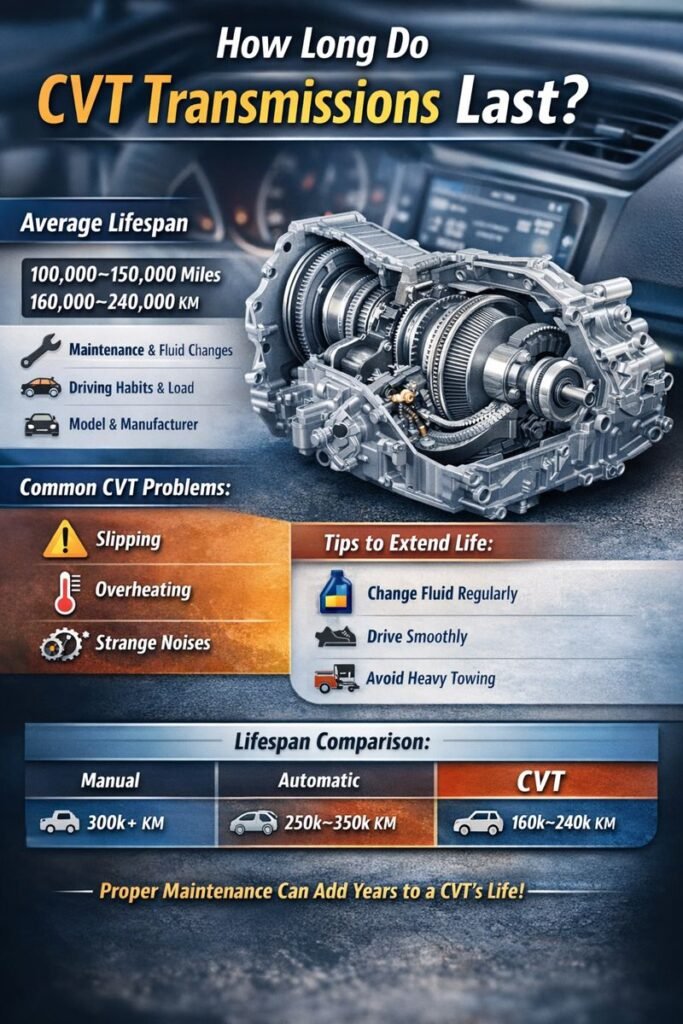
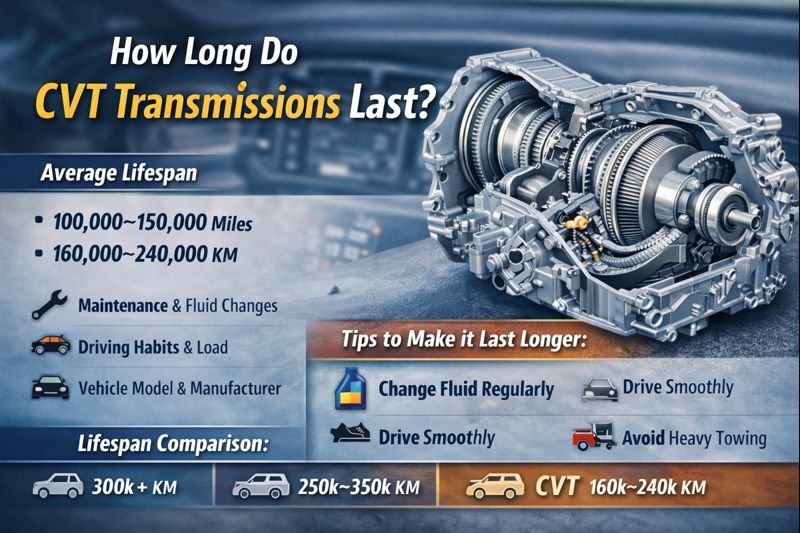
## ⏳ Average Lifespan of a CVT Transmission

There’s no single number that fits every vehicle, but typical ranges look like this:

### 📊 General CVT Lifespan Estimates

– **Good maintenance, normal driving:**
👉 **150,000 – 200,000 miles**
– **Poor maintenance, harsh driving:**
👉 CVT problems can start as early as **60,000 – 90,000 miles**
– **Best-case scenario with excellent care:**
👉 Some CVTs can go **well over 200,000 miles**

Your actual lifespan depends on:

– Brand and design quality
– Driving habits
– Maintenance frequency
– Driving environment (city vs highway, hot vs cold, towing, etc.)

## 🏷️ CVT Lifespan by Brand & Manufacturer

Not all CVTs are created equal. Here’s a general overview of how long major brands’ CVTs tend to last when properly maintained.

> ⚠️ Note: These are **approximate ranges**, not guarantees. Real results vary by model, year, and use.

### 🚙 Nissan CVT (Jatco)

– **Common in:** Altima, Sentra, Rogue, Murano, Versa
– **Average lifespan (well maintained):**
👉 **120,000 – 180,000 miles**
– **Known issues:**
– Overheating in earlier models
– Premature belt/pulley wear
– “Juddering,” slipping, and whining noises

Nissan has improved newer CVTs, but early 2000s–mid 2010s models developed a reputation for shorter lifespans when fluid changes were neglected.

### 🚗 Honda CVT

– **Common in:** Civic, Accord (4-cyl), CR-V, Fit, HR-V
– **Average lifespan (well maintained):**
👉 **150,000 – 200,000+ miles**
– **Strengths:**
– Generally more reliable than early Nissan units
– Handles daily driving well if serviced on time
– **Watch for:**
– Fluid contamination if service is overlooked
– Shuddering at low speeds from worn components

Honda is known for solid engineering, and many owners reach high mileage with no major CVT failures when following factory maintenance.

### 🚘 Toyota CVT

– **Common in:** Corolla, C-HR, RAV4 (some models), Camry (4-cyl in certain markets)
– **Average lifespan (well maintained):**
👉 **180,000 – 250,000+ miles**
– **Strengths:**
– Often among the most durable CVTs on the market
– Conservative tuning and strong cooling systems
– **Watch for:**
– Fluid still needs periodic changes despite some “lifetime” claims
– Aggressive driving shortens life

Toyota’s approach to CVT design and conservative software tuning tends to favor longevity.

### 🚗 Subaru CVT (Lineartronic)

– **Common in:** Outback, Forester, Legacy, Impreza, Crosstrek
– **Average lifespan (well maintained):**
👉 **150,000 – 200,000+ miles**
– **Strengths:**
– Well-matched to Subaru’s AWD systems
– Later models improved over earlier generations
– **Watch for:**
– Delayed engagement or shuddering
– Fluid issues if service is neglected

Subaru extended CVT warranties on some models due to early concerns, but many owners report long-term reliability with proper maintenance.

### 🚗 Mitsubishi, Hyundai, Kia & Others

– **Average lifespan (well maintained):**
👉 **120,000 – 180,000+ miles**
– **Key factors:**
– Design and cooling vary by model
– Some small-car CVTs are more lightly built
– Maintenance becomes even more critical

As with all CVTs, frequent stop-and-go driving and overheating are major lifespan killers.

## ⚙️ Key Factors That Affect CVT Lifespan

Several habits and conditions can either extend your CVT’s life or dramatically shorten it.

### 1. 🔄 Maintenance & Fluid Changes

**Most important factor.**
CVTs rely on **special CVT fluid**, not regular automatic transmission fluid (ATF).

– **Role of CVT fluid:**
– Lubricates high-pressure parts
– Cools the transmission
– Provides friction characteristics for the belt & pulleys

If the fluid breaks down or gets contaminated, internal wear accelerates quickly.

> 📌 **Tip:** Even if the manufacturer calls the fluid “lifetime,” it’s wise to replace it around **30,000–60,000 miles** depending on use.

### 2. 🛞 Driving Style

Harsh driving dramatically shortens CVT life:

– Hard acceleration from every stop
– Rapid throttle on/off behavior
– Driving at top speed for long periods
– Manual “shift mode” overuse (simulated gears) in aggressive driving

Gentle, smooth inputs help the CVT:

– Gradual acceleration
– Coasting when possible
– Avoiding constant heavy loads

### 3. 🏔️ Driving Conditions

Tough environments are harder on CVTs:

– **Hot climates** → higher risk of overheating
– **Hilly or mountainous areas** → more stress on the belt & pulleys
– **Dense city traffic** → constant stop-and-go, more heat
– **Off-road use** (if not designed for it) → extra strain and contamination

If you often drive in these conditions, you should **shorten CVT fluid intervals**.

### 4. 📦 Towing & Overloading

Many CVT-equipped vehicles have **limited or no towing capacity**. Overloading or towing beyond spec can:

– Overheat the CVT
– Stretch or damage the belt
– Cause early failure

> ✅ Always check your owner’s manual for **maximum towing limits** on CVT models.

### 5. 🌡️ Cooling System Health

CVTs depend heavily on proper cooling:

– Radiator & CVT cooler must be clean and functioning
– Overheating quickly breaks down fluid and damages components

If you see high temperature warnings or feel performance dropping on hot days or during long climbs, have the system checked.

## 🧰 How to Make Your CVT Transmission Last Longer

You can significantly extend CVT life with some simple but consistent habits.

### ✅ 1. Follow (or Improve on) the Service Schedule

– Check the **manufacturer’s recommended CVT service interval**
– In severe conditions (towing, hot climate, heavy traffic), service more often

Recommended practice in many cases:

– **Fluid change every 30,000–60,000 miles**
– **Filter replacement** where applicable

Always use:

– The **exact CVT fluid type** specified by the manufacturer
– A reputable shop experienced with CVTs

### ✅ 2. Warm Up Gently

On cold starts:

– Let the car idle for **30–60 seconds**
– Drive gently for the first **5–10 minutes**
– Avoid full-throttle acceleration or high speeds while cold

Cold fluid is thicker and doesn’t protect the transmission as well.

### ✅ 3. Drive Smoothly

Good habits:

– Accelerate gradually instead of flooring the pedal
– Avoid abrupt braking whenever possible
– Don’t “launch” the car from a stop repeatedly
– Avoid riding the throttle in stop-and-go; ease on and off

These reduce stress and wear on the belt, pulleys, and internal components.

### ✅ 4. Don’t Use “Neutral Drop” or Bad Shifting Habits

Avoid:

– Revving in **Neutral (N)** and dropping into **Drive (D)**
– Shifting between **Reverse (R)** and **Drive (D)** while the car is still moving
– Holding the car on steep hills using only the throttle (use the brake)

These behaviors cause shock loads that damage the CVT’s internal parts.

### ✅ 5. Watch for Overheating

Signals of overheating:

– Strange burning smell
– Warning lights on the dash (often a temperature or transmission light)
– Loss of power or “limp mode”

If this happens:

– Safely pull over
– Shift to **Park (P)**
– Let the engine idle and cool
– Seek service as soon as possible

## 🚨 Warning Signs Your CVT Might Be Failing

Addressing problems early can sometimes prevent a complete transmission failure.

### Common Symptoms of CVT Issues

1. **Shuddering or Jerking**
– Feels like the car vibrates or shakes under light acceleration

2. **Slipping**
– Engine revs climb, but the car doesn’t accelerate accordingly

3. **Whining or Humming Noises**
– Especially under acceleration or at certain speeds

4. **Delayed Engagement**
– Delay when shifting into Drive or Reverse before the car moves

5. **Overheating Warnings**
– Dashboard warning lights or messages relating to transmission

6. **Poor Fuel Economy**
– Sudden drop in MPG can indicate internal issues

7. **Check Engine Light (CEL)**
– CVT problems often trigger diagnostic trouble codes (DTCs)

> 📌 If you notice any of these, have the transmission inspected **immediately**. Continuing to drive can turn a minor issue into a full rebuild or replacement.

## 💰 CVT Repair vs Replacement: What to Expect

When a CVT starts to fail, repair costs can be significant.

### 🔧 Typical Cost Ranges

– **Minor service (fluid/filter/diagnosis):**
👉 **$200 – $500**
– **Component repair (valve body, sensors, solenoids):**
👉 **$600 – $1,500**
– **Full CVT rebuild:**
👉 **$2,000 – $4,000+** depending on model
– **Complete CVT replacement (new or remanufactured):**
👉 **$3,000 – $7,000+**

In many cases, especially on older or high-mileage vehicles, owners choose **replacement** rather than complex internal repairs.

## 🧾 Should You Buy a Car With a CVT?

CVTs can be a smart choice, but you should go in informed.

### 👍 Pros

– Superior fuel economy (especially in compact & midsize cars)
– Smooth driving in city traffic
– Often lower emissions and better efficiency ratings

### 👎 Cons

– Potentially higher repair/replacement costs
– Some models have known reliability concerns
– “Rubber band” feel may not satisfy performance drivers
– Sensitive to neglect and abuse

## 🕵️‍♂️ Buying a Used Car With a CVT: What to Check

If you’re considering a used vehicle with a CVT:

### 1. 📚 Maintenance Records

– Look for **documented CVT fluid changes**
– Avoid cars with **unknown or missing maintenance history**

### 2. 🔍 Test Drive Behavior

Pay attention to:

– Smooth, consistent acceleration
– No slipping or surging
– No odd noises (whining, humming, grinding)
– No jerks or delays when shifting between P, R, N, and D

### 3. 🧪 Professional Inspection

Before purchase:

– Have a trusted mechanic **scan for codes**
– Inspect for **fluid leaks**
– Check fluid level and condition (if accessible)

A little due diligence can save you from an expensive transmission replacement later.

## 🧮 CVT Longevity: Realistic Expectations

Summarizing typical lifespans under **proper maintenance** and **reasonable driving**:

– **Conservative expectation:**
👉 **120,000 – 150,000 miles**
– **Typical range for well-maintained vehicles:**
👉 **150,000 – 200,000 miles**
– **Best-case scenario (excellent care + reliable design):**
👉 **200,000+ miles**

If you plan to keep your vehicle **long-term**, budgeting for possible CVT work after **150,000 miles** is wise — especially on models with known issues.

## 📌 Key Takeaways: How Long Do CVT Transmissions Last?

– Most CVTs can last **150,000–200,000 miles** with **proper care**
– **Neglected maintenance** or harsh driving can lead to failures as early as **60,000–90,000 miles**
– **Brand and model matter** — Toyota, Honda, and later Subaru units often show better long-term reliability
– **Regular fluid changes** with the **correct CVT fluid** are critical
– Smooth driving, avoiding overload, and watching for early warning signs can dramatically extend CVT life

## 🛠️ Final Word: Protect Your CVT Investment

Your CVT doesn’t have to be a ticking time bomb. With:

– The **right maintenance schedule**
– **Gentle driving habits**
– Quick action when symptoms appear

…you can realistically enjoy **years and many miles** of trouble-free performance.

If you’re unsure of your current CVT’s condition or service history, the best next step is simple:

> ✅ Schedule a professional CVT inspection and fluid service.
> A relatively small maintenance cost today can prevent a very large repair bill tomorrow.

Share This Article
Leave a Comment

Laisser un commentaire

Votre adresse e-mail ne sera pas publiée. Les champs obligatoires sont indiqués avec *