

Continuously Variable Transmissions (CVTs) have become increasingly common in modern vehicles, especially in compact cars, sedans, and hybrids. Automakers promote CVTs for their smooth driving experience, improved fuel efficiency, and lower emissions. But one question concerns many car owners and buyers:
How long do CVT transmissions last?
In this in-depth guide, we’ll explore the average lifespan of CVT transmissions, the factors that affect their durability, how they compare to automatic and manual transmissions, and what you can do to extend the life of a CVT.
What Is a CVT Transmission?
A CVT (Continuously Variable Transmission) differs from traditional automatic or manual gearboxes. Instead of fixed gears, it uses:
Two variable-diameter pulleys
A steel belt or chain
A hydraulic or electronic control system
This design allows the transmission to provide infinite gear ratios, keeping the engine at optimal RPM for fuel efficiency and smooth acceleration.
Average Lifespan of a CVT Transmission
How Long Do CVT Transmissions Typically Last?
On average, a well-maintained CVT transmission can last:
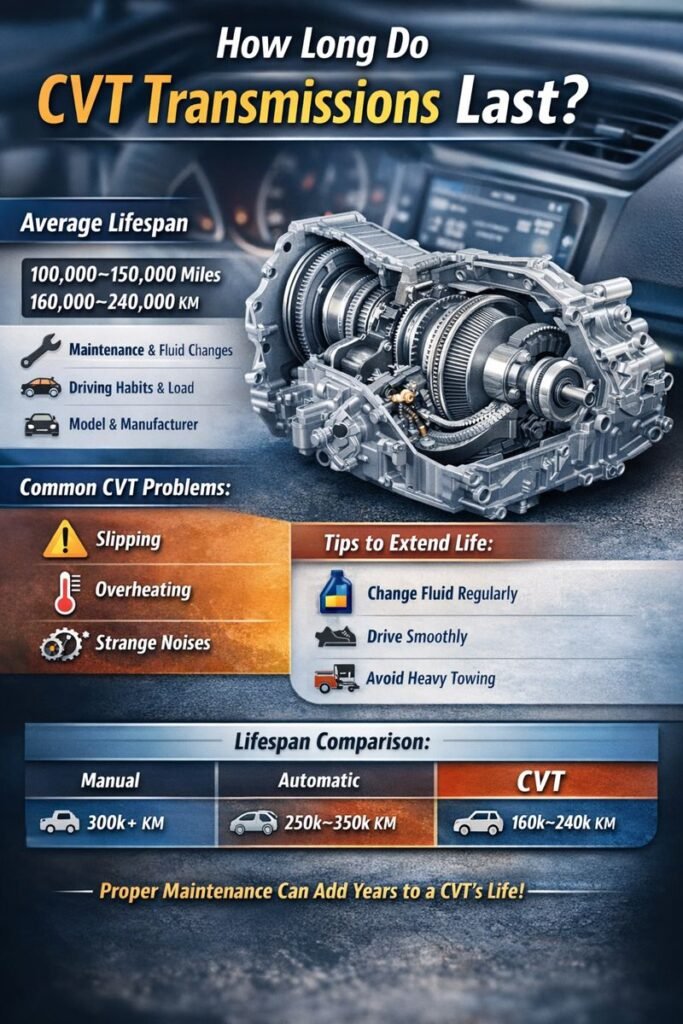
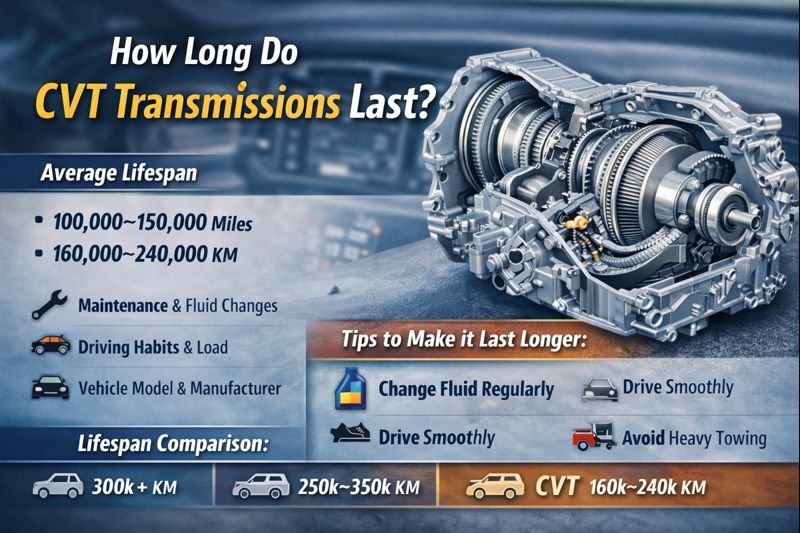
➡️ 160,000 to 240,000 kilometers (100,000 to 150,000 miles)
Some modern CVTs—especially newer designs from reputable manufacturers—can exceed 300,000 kilometers (185,000 miles) with excellent maintenance and gentle driving habits.
Older vs. Newer CVT Designs
Early CVTs (1990s–early 2010s):
Lifespan often limited to 120,000–160,000 km
Modern CVTs (2015+):
Improved materials, better cooling, stronger belts, and smarter software
Today’s CVTs are far more reliable than their early counterparts.
Factors That Affect CVT Transmission Longevity
- Maintenance and Fluid Changes
CVTs rely heavily on specialized transmission fluid. Dirty or degraded fluid leads to overheating and internal wear.
Recommended fluid change interval:
Every 40,000–60,000 km (25,000–40,000 miles)
Always use manufacturer-approved CVT fluid
Skipping fluid changes is the number one reason CVTs fail early.
- Driving Style
Aggressive driving dramatically shortens CVT life.
🚫 Harmful habits:
Hard acceleration
Towing heavy loads (unless CVT is rated for it)
Sudden gear changes
Stop-and-go driving without proper warm-up
✅ CVT-friendly habits:
Smooth acceleration
Gradual braking
Gentle throttle inputs
- Vehicle Weight and Engine Power
CVTs perform best in:
Compact cars
Sedans
Hybrids
They experience more stress in:
SUVs
Heavy vehicles
High-torque engines
Some manufacturers (like Toyota and Subaru) design reinforced CVTs for heavier vehicles, improving durability.
- Manufacturer and Model Reliability
Not all CVTs are equal.
Generally reliable CVT brands:
Toyota
Honda (newer models)
Subaru
Lexus
Mixed reliability (older models):
Nissan (pre-2018 CVTs had common issues)
Mitsubishi
Jeep (early CVT applications)
Modern revisions have improved most past reliability concerns.
CVT vs Automatic vs Manual: Lifespan Comparison
Transmission Type Average Lifespan
Manual 300,000+ km
Automatic (AT) 250,000–350,000 km
CVT 160,000–240,000 km
📌 While CVTs often have a shorter lifespan, they offer:
Better fuel economy
Smoother driving
Lower emissions
Common CVT Problems That Shorten Lifespan
Knowing early warning signs can prevent total failure.
Typical CVT Issues
Slipping or shuddering
Delayed acceleration
Overheating
Whining or humming noises
Transmission warning light
Ignoring these symptoms can lead to complete CVT failure, which is costly.
Cost of Replacing a CVT Transmission
CVTs are complex and expensive to repair.
Repair cost: $1,500 – $3,500
Replacement cost: $4,000 – $8,000+
In many cases, replacement is more common than rebuilding.
How to Make a CVT Transmission Last Longer
Best Practices for Maximum CVT Lifespan
✅ Change CVT fluid on schedule
✅ Use only OEM or approved CVT fluid
✅ Avoid aggressive driving
✅ Let the car warm up before hard driving
✅ Do not exceed towing limits
✅ Fix small issues early
Following these steps can add 50,000–100,000 km to a CVT’s lifespan.
Are CVT Transmissions Reliable Today?
Yes—modern CVTs are significantly more reliable than earlier versions.
Thanks to:
Stronger steel belts
Improved cooling systems
Advanced electronic controls
Most drivers can expect 10–15 years of service from a properly maintained CVT.
Should You Buy a Car With a CVT?
A CVT is a good choice if you value:
Fuel efficiency
Smooth city driving
Low emissions
Comfortable daily commuting
It may not be ideal if you:
Tow frequently
Drive aggressively
Prefer sporty performance feel
Final Verdict: How Long Do CVT Transmissions Last?
A CVT transmission typically lasts between 160,000 and 240,000 kilometers, and often longer with proper care. Maintenance, driving habits, and manufacturer quality play a crucial role in determining its lifespan.