



🚗 Introduction (Why This Matters)
Few things strike fear into a car owner’s heart like hearing the words “your transmission is failing.” A slipping gear, a hard shift, or a mysterious grinding noise can quickly turn into a $3,000–$6,000 repair bill — sometimes more than the car is worth.
- 🚗 Introduction (Why This Matters)
- 📊 The Core Answer: Transmission Lifespan at a Glance
- 🔬 Deep Dive: Why Manuals Usually Last Longer
- 🧩 The 5 Factors That Decide How Long Your Transmission Lasts
- 1️⃣ Maintenance – The #1 Rule
- 2️⃣ Driving Habits & Conditions
- 3️⃣ Vehicle Design & Model Year
- 4️⃣ The Clutch Factor (Manual Only)
- 5️⃣ Fluids: The Lifeblood of Transmissions
- 🚨 Warning Signs of Transmission Failure
- 💰 Cost Analysis: Repair vs Replacement
- 🏁 Final Verdict
- ❓ FAQ
So the big question becomes:
How long do transmissions last — and is an automatic or manual transmission more reliable?
Whether you drive a daily commuter, run a high-mileage Uber car, or are shopping for a used vehicle, understanding transmission lifespan can save you thousands of dollars.
In this definitive guide, we’ll break down how long automatic and manual transmissions really last, why they fail, how driving habits affect them, and what you can do to make yours last as long as possible.
By the end, you’ll know exactly which transmission type offers the best long-term value and how to avoid expensive surprises.
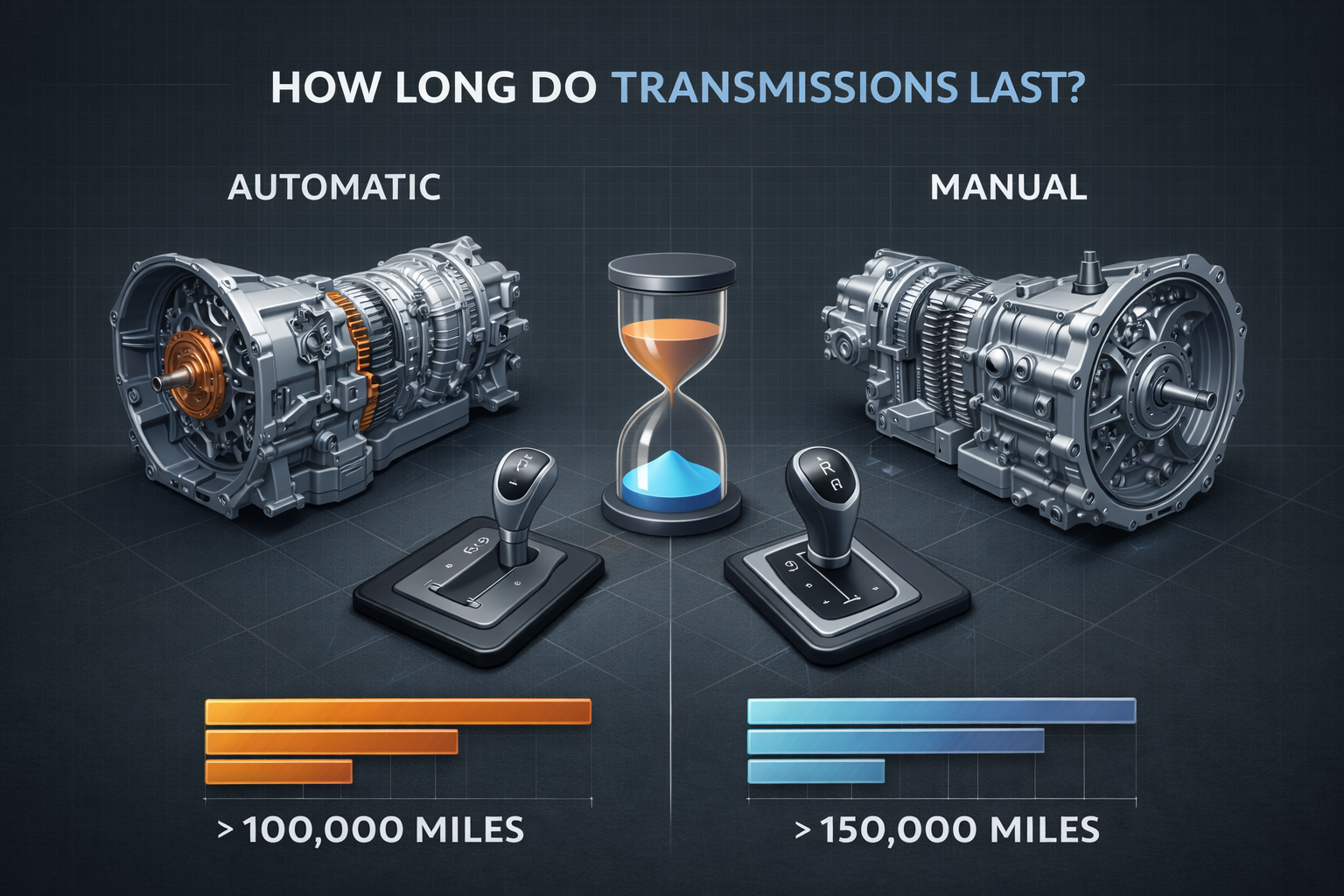
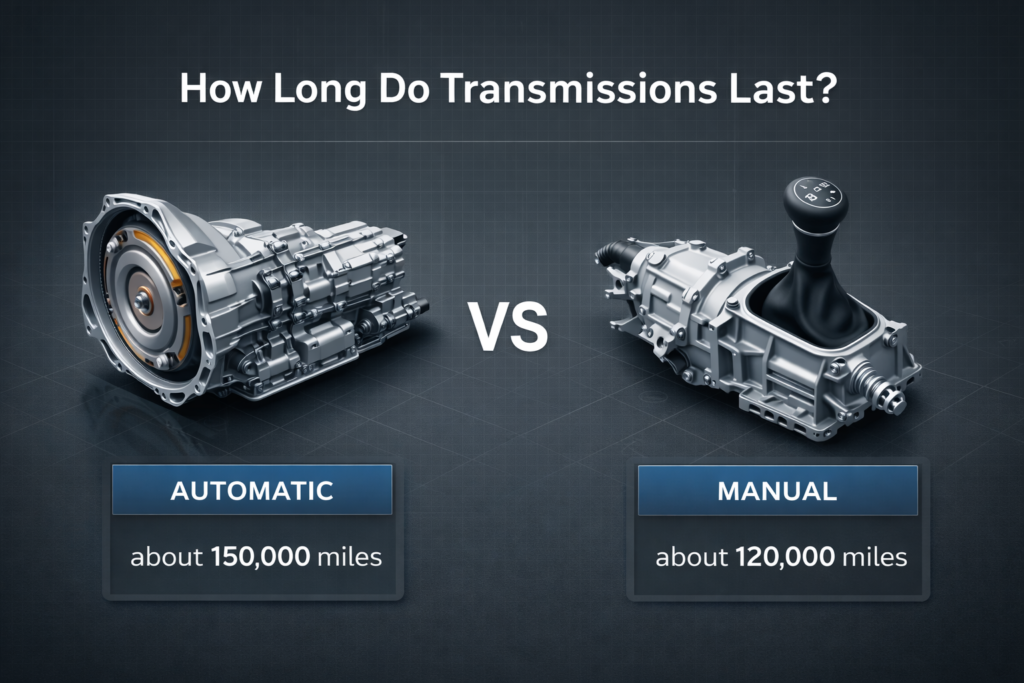
📊 The Core Answer: Transmission Lifespan at a Glance
Typical Transmission Lifespan
| Transmission Type | Typical Lifespan (Miles) | Key Influencing Factor |
|---|---|---|
| Modern Automatic | 150,000 – 200,000+ | Fluid condition & service history |
| Traditional Manual | 200,000 – 300,000+ | Clutch usage & driver skill |
👉 These are real-world averages, not best-case marketing numbers.
A neglected automatic might fail at 90,000 miles.
A well-maintained manual can exceed 350,000 miles.
The difference comes down to complexity, heat, and maintenance — which we’ll explain next.
🔬 Deep Dive: Why Manuals Usually Last Longer
⚙️ How an Automatic Transmission Works (and Wears)
Automatic transmissions are engineering marvels. They use:
- Torque converters
- Planetary gearsets
- Hydraulic pressure
- Electronic solenoids
- Internal clutch packs
All of this relies on transmission fluid (ATF) to:
- Transfer power
- Cool components
- Lubricate gears
- Apply hydraulic pressure
Over time, ATF breaks down from heat and contamination. Once fluid degrades:
- Valves stick
- Clutches slip
- Gears wear faster
That’s why automatic transmission lifespan is highly dependent on fluid quality.
⚙️ How a Manual Transmission Works (and Wears)
A manual transmission is much simpler:
- Fixed gears
- Synchronizers
- A clutch
- Manual shifting
There are no hydraulics, no solenoids, no computer-controlled clutches.
The gearbox itself often lasts 300,000+ miles.
The weak point is the clutch, which is a wear item — like brake pads.
That’s why manual transmission mileage is often higher overall.
🧩 The 5 Factors That Decide How Long Your Transmission Lasts
1️⃣ Maintenance – The #1 Rule
Nothing matters more than maintenance.
Automatic Transmission Maintenance
- Fluid change every 40,000–60,000 miles
- Filter replacement
- Cooling system health
Skipping fluid changes is the #1 cause of automatic failure.
Manual Transmission Maintenance
- Gear oil change every 60,000–100,000 miles
- Clutch inspection
- Hydraulic fluid checks
Cost comparison:
- ATF service: $150–$300
- Transmission replacement: $3,500–$7,000
That’s a 10–20× return on maintenance.
2️⃣ Driving Habits & Conditions
Your right foot determines transmission life.
| Driving Style | Effect on Transmission |
|---|---|
| Stop-and-go traffic | Hard on automatics |
| Highway cruising | Best for both |
| Aggressive driving | Wears both faster |
| Towing heavy loads | Overheats automatics |
| Riding the clutch | Kills manuals |
City taxis often destroy automatics at 120k–150k miles
Highway commuters see 250k+
3️⃣ Vehicle Design & Model Year
Some transmissions are legendary. Others… not so much.
Known for longevity
- Toyota Aisin automatics
- Honda & Mazda manuals
- ZF 8-speed automatic (BMW, Audi, Dodge)
Known problem units
- Nissan CVT
- Ford PowerShift DCT
- Some early 8–10 speed automatics
Modern automatics have 8–10 gears — great for fuel economy, but more complexity means more failure points.
4️⃣ The Clutch Factor (Manual Only)
The clutch is the wear item in a manual.
Typical clutch lifespan:
- 60,000 – 120,000 miles
- Some exceed 150,000 miles with good driving
Bad habits that destroy clutches:
- Riding the clutch
- Hard launches
- Holding on hills
- Slipping instead of shifting
Replacing a clutch costs $600–$1,800 — far cheaper than an automatic rebuild.
5️⃣ Fluids: The Lifeblood of Transmissions
Manufacturers often claim “lifetime fluid.”
Mechanics call this a marketing myth.
Heat kills transmissions.
Old fluid = overheating.
Use the exact ATF spec required by the manufacturer. Wrong fluid can destroy a transmission in months.
🚨 Warning Signs of Transmission Failure
Automatic Transmission Symptoms
- Slipping gears
- Delayed engagement
- Hard or jerky shifts
- Burning smell
- Fluid leaks
- Check engine light
Manual Transmission Symptoms
- Grinding gears
- Clutch slipping
- Shuddering on takeoff
- Hard to shift
- Gear pop-out
Ignoring early signs turns a $200 repair into a $5,000 replacement.
💰 Cost Analysis: Repair vs Replacement
| Repair Type | Typical Cost |
|---|---|
| Automatic fluid service | $150–$300 |
| Automatic rebuild | $2,500–$5,000 |
| New automatic transmission | $4,000–$8,000 |
| Manual clutch replacement | $600–$1,800 |
| Manual transmission rebuild | $1,500–$3,500 |
Preventive maintenance costs pennies compared to replacement.
🏁 Final Verdict
So — how long do transmissions last?
With proper care:
- Automatics: 150,000–200,000+ miles
- Manuals: 200,000–300,000+ miles
Manual transmissions usually last longer because they are simpler, cooler-running, and cheaper to repair. However, modern automatics can easily reach 200,000 miles when properly maintained.
If you want:
- Lowest ownership cost → Manual
- Maximum convenience → Automatic
Either way, fluid changes and driving habits matter more than design.
❓ FAQ
Can a transmission last 300,000 miles?
Yes. Many manual transmissions and well-maintained automatics reach 300k+ miles, especially in highway-driven vehicles.
What is the most reliable transmission ever made?
Toyota’s Aisin automatics and Honda’s manual gearboxes are widely considered among the most durable ever built.
Is it worth replacing a transmission on a high-mileage car?
If the vehicle is otherwise solid, a remanufactured transmission can add another 100,000+ miles for less than a new car.
How often should you change automatic transmission fluid?
Every 40,000–60,000 miles — regardless of “lifetime” claims.