

Introduction
The automotive industry has continuously evolved to improve vehicle performance, fuel efficiency, and driving comfort. Among the various transmission technologies available today, the Continuously Variable Transmission (CVT) has become increasingly popular in passenger vehicles. Found in many modern cars from manufacturers such as Nissan, Honda, Toyota, Subaru, and Mitsubishi, CVTs offer a unique approach to power delivery compared to traditional automatic and manual transmissions.
- Introduction
- 1. Belt-Driven CVT
- 2. Chain-Driven CVT
- 3. Toroidal CVT
- 4. eCVT (Electronic CVT)
- Superior Fuel Efficiency
- Smooth Driving Experience
- Improved Engine Performance
- Reduced Mechanical Complexity
- Unusual Driving Feel
- Limited Torque Capacity
- Higher Repair Costs
- Heat Sensitivity
- Early CVT Issues
- Modern CVT Improvements
- Transmission Shudder
- Overheating
- Delayed Response
- Fluid Degradation
This comprehensive guide explains how CVT transmissions work, their advantages and disadvantages, reliability concerns, and how they compare to other transmission types.
What Is a CVT Transmission?
A Continuously Variable Transmission (CVT) is an automatic transmission system that can change seamlessly through an infinite range of gear ratios. Unlike conventional automatic transmissions that use a fixed number of gears (such as 6-speed, 8-speed, or 10-speed automatics), a CVT continuously adjusts the transmission ratio to maintain optimal engine performance.
The primary objective of a CVT is to keep the engine operating within its most efficient RPM range while delivering the required power to the wheels.
Key Components of a CVT
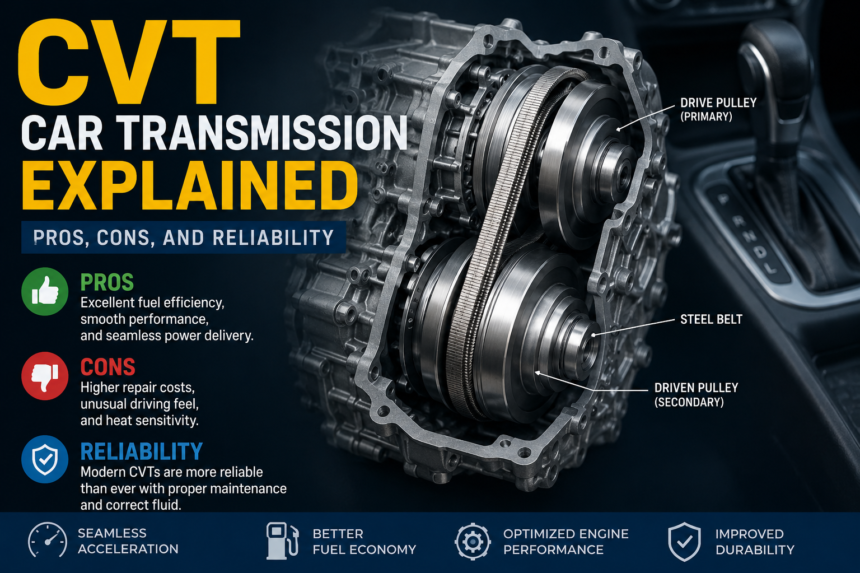
A typical belt-driven CVT consists of:
- Drive pulley (primary pulley)
- Driven pulley (secondary pulley)
- High-strength steel belt or chain
- Hydraulic control system
- Transmission Control Module (TCM)
- Torque converter or starting clutch
The system continuously adjusts the pulley diameters to vary the gear ratio without any noticeable gear shifts.
How Does a CVT Work?
The operation of a CVT is based on two variable-diameter pulleys connected by a steel belt or chain.
Low-Speed Operation
At low vehicle speeds:
- The drive pulley has a small effective diameter.
- The driven pulley has a large effective diameter.
- The transmission produces a low gear ratio.
This configuration maximizes torque multiplication for vehicle acceleration.
High-Speed Operation
As vehicle speed increases:
- The drive pulley diameter expands.
- The driven pulley diameter contracts.
- The gear ratio becomes taller.
This reduces engine RPM while maintaining vehicle speed, improving fuel economy.
Continuous Ratio Adjustment
Unlike traditional transmissions that shift between fixed gears, a CVT continuously adjusts the pulley positions, allowing smooth acceleration without shift shock.
Types of CVT Transmissions
Several CVT designs exist in the automotive market.
1. Belt-Driven CVT
The most common design uses:
- Steel belt
- Variable pulleys
- Hydraulic actuators
Applications include:
- Nissan Xtronic CVT
- Honda CVT
- Toyota Direct Shift-CVT
2. Chain-Driven CVT
Uses a steel chain instead of a belt.
Advantages include:
- Higher torque capacity
- Improved durability
- Better efficiency
Commonly used by premium manufacturers.
3. Toroidal CVT
Uses rotating discs and rollers instead of belts.
Benefits:
- Reduced friction losses
- High torque capability
However, manufacturing costs remain high.
4. eCVT (Electronic CVT)
Used primarily in hybrid vehicles.
Examples include:
- Toyota Hybrid Synergy Drive
- Lexus Hybrid systems
Unlike conventional CVTs, eCVTs rely on planetary gearsets and electric motors rather than belts and pulleys.
Advantages of CVT Transmissions
CVT technology offers several benefits that have contributed to its widespread adoption.
Superior Fuel Efficiency
One of the biggest advantages of a CVT is its ability to keep the engine operating near its most efficient RPM range.
Benefits include:
- Lower fuel consumption
- Reduced emissions
- Improved highway economy
Many manufacturers achieve fuel economy gains of 5% to 15% compared to traditional automatic transmissions.
Smooth Driving Experience
Because there are no fixed gear changes:
- Acceleration feels seamless.
- Gear hunting is eliminated.
- Passengers experience less vibration.
This makes CVTs particularly attractive for urban driving.
Improved Engine Performance
The transmission can instantly select the ideal gear ratio for:
- Acceleration
- Climbing hills
- Cruising
This allows the engine to remain in its optimal power band.
Reduced Mechanical Complexity
Compared to conventional automatic transmissions, CVTs often contain fewer:
- Planetary gearsets
- Clutches
- Shift mechanisms
This can reduce manufacturing complexity.
Disadvantages of CVT Transmissions
Despite their benefits, CVTs also have several drawbacks.
Unusual Driving Feel
Many drivers describe the CVT driving experience as:
- Less engaging
- Less sporty
- Artificial
During hard acceleration, engine RPM may remain constant while vehicle speed increases, creating a “rubber-band effect.”
Limited Torque Capacity
Traditional CVTs struggle with very high torque outputs.
For this reason:
- Heavy-duty trucks rarely use CVTs.
- High-performance sports cars generally prefer dual-clutch or automatic transmissions.
Higher Repair Costs
When internal CVT components fail:
- Repairs can be expensive.
- Complete replacement is often required.
- Specialized technicians may be necessary.
Heat Sensitivity
CVTs generate significant heat during operation.
Without proper cooling:
- Belt wear increases.
- Fluid degradation accelerates.
- Transmission lifespan may decrease.
CVT vs Traditional Automatic Transmission
The following comparison highlights key differences.
| Feature | CVT | Traditional Automatic |
|---|---|---|
| Gear Ratios | Infinite | Fixed |
| Fuel Economy | Excellent | Good |
| Acceleration Smoothness | Very Smooth | Moderate |
| Driving Feel | Less Sporty | More Traditional |
| Maintenance Cost | Moderate to High | Moderate |
| Torque Capacity | Limited | Higher |
| Complexity | Lower Mechanical Complexity | More Complex |
For daily commuting and fuel efficiency, CVTs often outperform conventional automatics.
CVT vs Dual-Clutch Transmission (DCT)
Dual-Clutch Transmissions have become popular in performance vehicles.
| Feature | CVT | DCT |
|---|---|---|
| Shift Speed | Continuous | Extremely Fast |
| Fuel Efficiency | Excellent | Very Good |
| Driving Comfort | Smooth | Sporty |
| Performance Driving | Average | Excellent |
| Maintenance Cost | Moderate | High |
| Torque Handling | Moderate | High |
Drivers seeking performance generally prefer DCTs, while those prioritizing comfort and efficiency often choose CVTs.
CVT Reliability: Are CVTs Reliable?
Reliability remains one of the most debated topics regarding CVT transmissions.
The answer depends largely on:
- Manufacturer
- Maintenance practices
- Driving conditions
- Transmission generation
Early CVT Issues
Older CVT systems, particularly from the late 2000s and early 2010s, experienced problems such as:
- Premature belt wear
- Pulley damage
- Overheating
- Valve body failures
Some early Nissan CVT models gained a reputation for reduced durability due to these issues.
Modern CVT Improvements
Manufacturers have significantly improved CVT technology through:
- Stronger steel belts
- Improved cooling systems
- Enhanced transmission fluids
- Better electronic controls
Modern CVTs from Toyota, Honda, and Subaru have generally demonstrated improved reliability.
Common CVT Problems
Even modern CVTs may develop certain issues over time.
Transmission Shudder
Symptoms include:
- Vibration during acceleration
- Jerking sensations
- Hesitation
Possible causes:
- Worn belt
- Fluid contamination
- Pulley wear
Overheating
Excessive heat can lead to:
- Reduced efficiency
- Accelerated wear
- Internal damage
Delayed Response
Drivers may notice:
- Sluggish acceleration
- RPM fluctuations
- Power delivery delays
These symptoms can indicate electronic or hydraulic control issues.
Fluid Degradation
CVT fluid plays a critical role in:
- Lubrication
- Cooling
- Hydraulic control
Using incorrect fluid can quickly damage the transmission.
CVT Maintenance Tips
Proper maintenance significantly improves CVT lifespan.
Recommended Practices
- Follow manufacturer fluid change intervals.
- Use only approved CVT fluid.
- Avoid excessive towing beyond rated capacity.
- Maintain proper cooling system operation.
- Address warning lights immediately.
Fluid Replacement
Many experts recommend changing CVT fluid every:
- 40,000 to 60,000 miles (64,000 to 96,000 km)
This interval may vary depending on driving conditions and manufacturer specifications.
Expected CVT Lifespan
A well-maintained modern CVT can often last:
| Maintenance Level | Expected Lifespan |
|---|---|
| Poor Maintenance | 80,000–120,000 miles |
| Average Maintenance | 120,000–180,000 miles |
| Excellent Maintenance | 180,000–250,000+ miles |
Proper servicing is the single most important factor influencing transmission longevity.
Should You Buy a Vehicle with a CVT?
For most drivers, the answer is yes.
A CVT is an excellent choice if you prioritize:
- Fuel economy
- Comfortable commuting
- Smooth acceleration
- Lower emissions
However, drivers seeking:
- Aggressive performance
- Heavy towing capability
- Traditional shifting feel
may prefer a conventional automatic or dual-clutch transmission.
Conclusion
The Continuously Variable Transmission has transformed modern vehicle design by providing smoother operation and improved fuel efficiency compared to traditional automatic transmissions. While early CVTs faced reliability concerns, modern systems have become significantly more durable thanks to advances in materials, cooling technology, and electronic controls.
Like any automotive component, reliability depends heavily on proper maintenance and driving habits. For everyday drivers focused on efficiency, comfort, and lower operating costs, a modern CVT-equipped vehicle can be an excellent long-term investment.
As automotive technology continues to evolve, CVTs are likely to remain a key transmission solution, particularly in fuel-efficient and hybrid vehicles where maximizing engine efficiency is critical.