

Modern Dodge diesel trucks are built to deliver exceptional towing capacity, fuel efficiency, and durability. Whether you own a Dodge Ram 2500 or 3500 equipped with the legendary Cummins diesel engine, one emission component plays a critical role in keeping your truck running efficiently: the Diesel Particulate Filter (DPF).
- 1. Check Engine Light
- 2. DPF Warning Light
- 3. Reduced Engine Power
- 4. Increased Fuel Consumption
- 5. Excessive Exhaust Backpressure
- 6. Frequent Regeneration
- 7. Limp Mode
- 1. Short Trips
- 2. Excessive Idling
- 3. Faulty Fuel Injectors
- 4. Turbocharger Problems
- 5. EGR Valve Malfunction
- 6. Poor Quality Diesel Fuel
- 7. Engine Oil Consumption
- 8. Faulty DPF Pressure Sensor
- Method 1 – Passive Regeneration
- Method 2 – Parked Regeneration
- Method 3 – Forced Regeneration
- Method 4 – Professional DPF Cleaning
- Method 5 – DPF Replacement
- How often should a Dodge DPF be cleaned?
- Can DPF cleaner additives solve the problem?
- Does removing the DPF improve performance?
- How long does professional DPF cleaning take?
- What diagnostic codes are associated with DPF problems?
Unfortunately, many Dodge owners only discover the importance of the DPF after the check engine light appears, power drops, fuel economy decreases, or the truck enters limp mode.
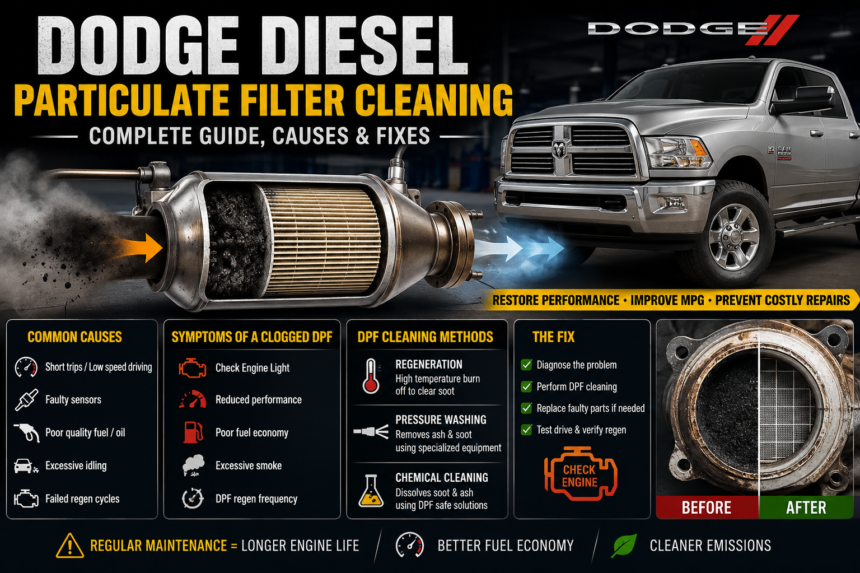
This comprehensive guide explains everything you need to know about Dodge Diesel Particulate Filter cleaning, including how the DPF works, symptoms of a clogged filter, common causes, cleaning methods, repair costs, and preventive maintenance.
What Is a Diesel Particulate Filter (DPF)?
The Diesel Particulate Filter is an emissions control device installed in the exhaust system of diesel vehicles.
Its purpose is simple:
- Capture soot particles
- Prevent harmful emissions
- Meet EPA emission standards
- Improve environmental performance
Instead of allowing black smoke to exit the tailpipe, the DPF traps microscopic soot inside its ceramic honeycomb structure.
Over time, the filter fills with soot and must be cleaned through a process called regeneration.
How Does the Dodge DPF Work?
The DPF continuously traps soot while driving.
When soot reaches a certain level, the Engine Control Module (ECM) initiates regeneration by increasing exhaust temperatures to approximately 550–650°C (1022–1202°F).
This burns the soot into fine ash.
Unlike soot, ash cannot burn away.
Eventually ash accumulates and requires professional cleaning.
Types of DPF Regeneration
| Regeneration Type | How It Works | Driver Action Required |
|---|---|---|
| Passive Regeneration | Happens automatically during highway driving | No |
| Active Regeneration | ECM injects additional fuel to raise exhaust temperature | No |
| Parked Regeneration | Driver initiates regeneration while parked | Yes |
| Forced Regeneration | Performed using professional diagnostic equipment | Technician Required |
Symptoms of a Clogged Dodge Diesel Particulate Filter
A blocked DPF affects both engine performance and fuel economy.
Common symptoms include:
1. Check Engine Light
The ECM detects excessive soot loading and stores diagnostic trouble codes.
2. DPF Warning Light
Many Dodge diesel trucks have a dedicated DPF indicator.
Ignoring this warning often leads to limp mode.
3. Reduced Engine Power
The engine cannot expel exhaust gases efficiently.
The result is:
- Slow acceleration
- Poor towing performance
- Limited RPM
4. Increased Fuel Consumption
Frequent regeneration cycles consume additional diesel fuel.
Many owners notice fuel economy dropping by 10–20%.
5. Excessive Exhaust Backpressure
A clogged filter restricts exhaust flow.
This increases engine workload and turbocharger stress.
6. Frequent Regeneration
If regeneration occurs every few hundred miles instead of every several hundred to over a thousand miles (depending on driving conditions), excessive soot accumulation may be present.
7. Limp Mode
When soot loading becomes critical, the ECM limits engine power to protect the engine and emissions system.
Comparison Table: Healthy vs Clogged DPF
| Condition | Healthy DPF | Clogged DPF |
|---|---|---|
| Engine Power | Excellent | Reduced |
| Fuel Economy | Normal | Increased consumption |
| Turbo Performance | Normal | Restricted |
| Exhaust Flow | Free | Restricted |
| Regeneration Frequency | Occasional | Very frequent |
| Engine Temperature | Normal | Higher |
| Check Engine Light | Off | Usually On |
| Limp Mode | No | Possible |
Common Causes of Dodge DPF Clogging
1. Short Trips
Driving only short distances prevents the exhaust from reaching regeneration temperature.
This is the number one cause of DPF problems.
2. Excessive Idling
Diesel engines produce soot at idle while generating little heat.
Fleet vehicles and work trucks are especially affected.
3. Faulty Fuel Injectors
Poor injector spray patterns create excessive soot.
Symptoms include:
- Black smoke
- Rough idle
- High fuel consumption
4. Turbocharger Problems
A worn turbo reduces air supply, resulting in incomplete combustion and increased soot production.
5. EGR Valve Malfunction
A faulty Exhaust Gas Recirculation valve can dramatically increase soot accumulation inside the DPF.
6. Poor Quality Diesel Fuel
Low-quality fuel burns less efficiently and produces more particulate matter.
7. Engine Oil Consumption
Burning engine oil creates ash that cannot be removed during regeneration.
8. Faulty DPF Pressure Sensor
The ECM may incorrectly calculate soot loading, triggering unnecessary regeneration or preventing regeneration altogether.
DPF Cleaning Methods
Several cleaning options are available depending on the severity of blockage.
Method 1 – Passive Regeneration
The easiest and cheapest method.
Drive continuously at highway speed for approximately 30–45 minutes while maintaining sufficient engine load.
Best for:
- Light soot accumulation
Method 2 – Parked Regeneration
Available on many Dodge Cummins trucks.
The truck performs regeneration while stationary.
Typical duration:
20–40 minutes.
Method 3 – Forced Regeneration
Performed by professional technicians using diagnostic equipment.
Recommended when:
- DPF warning light remains on
- Vehicle enters limp mode
- Regeneration repeatedly fails
Method 4 – Professional DPF Cleaning
The filter is removed and cleaned using specialized equipment.
Methods include:
- Air pulse cleaning
- Thermal baking
- Water flushing (where appropriate)
- Ultrasonic cleaning
Professional cleaning can restore 90–98% of the original flow capacity when the filter is structurally sound.
Method 5 – DPF Replacement
Replacement becomes necessary if:
- Ceramic core is cracked
- Filter is melted
- Excessive ash accumulation cannot be removed
- Internal substrate is damaged
Comparison Table: DPF Cleaning Methods
| Cleaning Method | Effectiveness | Cost | Suitable For |
|---|---|---|---|
| Highway Driving | Low-Medium | Free | Light soot |
| Parked Regen | Medium | Free | Moderate soot |
| Forced Regen | High | $$ | Heavy soot |
| Professional Cleaning | Very High | $$$ | Ash accumulation |
| Replacement | 100% | $$$$ | Damaged DPF |
Can You Drive with a Clogged DPF?
Technically yes—but it is not recommended.
Driving with a blocked DPF may lead to:
- Turbocharger failure
- Exhaust overheating
- Engine derating
- Higher fuel consumption
- Costly repairs
- Permanent DPF damage
Ignoring the issue can turn a relatively inexpensive cleaning into a much more expensive repair.
Dodge DPF Cleaning Cost
Approximate repair costs vary depending on location and vehicle model.
| Service | Estimated Cost (USD) |
|---|---|
| Passive Regeneration | Free |
| Parked Regeneration | Free |
| Forced Regeneration | $100–250 |
| Professional Cleaning | $300–700 |
| Pressure Sensor Replacement | $150–400 |
| Differential Pressure Hoses | $50–150 |
| New DPF | $1,500–4,000+ |
How to Prevent DPF Problems
Proper maintenance can significantly extend DPF life.
Follow these recommendations:
- Drive at highway speed regularly to allow passive regeneration.
- Avoid excessive idling whenever possible.
- Use high-quality diesel fuel.
- Use engine oil that meets the manufacturer’s low-ash specification.
- Replace clogged air filters on schedule.
- Repair fuel injector issues promptly.
- Address turbocharger problems before they increase soot production.
- Never ignore DPF or check engine warning lights.
- Follow the recommended maintenance schedule for your Dodge diesel.
Frequently Asked Questions
How often should a Dodge DPF be cleaned?
Under normal conditions, professional cleaning may be needed between 100,000 and 200,000 miles (160,000–320,000 km). Actual intervals depend on driving habits, maintenance, and engine condition.
Can DPF cleaner additives solve the problem?
Fuel additives may help reduce soot formation in some situations, but they cannot remove ash or repair a severely clogged DPF. They should not be considered a substitute for proper diagnosis and maintenance.
Does removing the DPF improve performance?
Removing emissions equipment is illegal in many jurisdictions, may cause inspection failures, and can result in fines or warranty issues. Proper maintenance is the recommended approach.
How long does professional DPF cleaning take?
Most cleaning services require between 2 and 6 hours, depending on the level of contamination and the cleaning process used.
What diagnostic codes are associated with DPF problems?
Common DTCs related to the DPF system include:
- P2002 – DPF efficiency below threshold
- P2463 – Excessive soot accumulation
- P2459 – Regeneration frequency issue
- P2453 – DPF differential pressure sensor circuit
A professional scan tool is needed to confirm the root cause, as similar symptoms can also be caused by injector, turbocharger, EGR, or sensor faults.
Final Thoughts
The Diesel Particulate Filter is one of the most important components of your Dodge diesel truck’s emissions system. While it operates quietly in the background, neglecting it can lead to reduced performance, increased fuel consumption, repeated regeneration cycles, limp mode, and expensive repairs.
Fortunately, most DPF issues are preventable through proper driving habits, timely maintenance, and prompt attention to warning lights. If your Dodge Cummins is showing signs of a clogged DPF, start with a thorough diagnosis to determine whether regeneration, professional cleaning, or component repair is required. Taking action early can restore engine performance, protect the turbocharger and exhaust system, and help you avoid the much higher cost of replacing the DPF altogether.