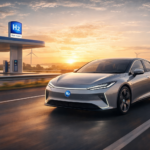


# Solar Roof Technology in Cars Explained: The Future of Clean Mobility ☀️🚗
Solar roof technology in cars is no longer science fiction. From premium electric vehicles to innovative hybrids and even concept cars, more automakers are experimenting with ways to turn sunlight into usable energy right on the roof of your car.
In this detailed guide, we’ll explain exactly how solar roofs in cars work, what they can and can’t do, which brands are using them, and whether it’s worth considering for your next vehicle.
—
## 🔍 What Is Solar Roof Technology in Cars?
**Solar roof technology** refers to the integration of **photovoltaic (PV) solar panels** into a vehicle’s exterior surfaces—most commonly the roof, but sometimes the hood, trunk, or even glass surfaces.
These solar panels convert sunlight into electricity that can be used to:
– Power auxiliary systems (fans, ventilation, lights, infotainment)
– Assist the 12V battery or high-voltage traction battery
– Slightly extend the vehicle’s driving range (for hybrids/EVs)
In short, you’re turning your car into a mini power station whenever it’s parked or driving in the sun.
—
## ⚙️ How Does a Solar Roof on a Car Work?
The process is similar to rooftop solar on a house, but designed for a **smaller, curved, and mobile surface**.
### 1. Solar Cells Capture Sunlight ☀️
The car roof is covered with **solar cells**, usually:
– **Monocrystalline silicon cells** (high efficiency, common in automotive)
– Sometimes **thin-film** solar for curved/irregular surfaces
These cells absorb photons from sunlight and create an electrical current.
### 2. DC Power Is Generated 🔌
The solar cells produce **direct current (DC)** electricity. The output depends on:
– Sun intensity
– Angle of the sun
– Temperature
– Shading (trees, buildings, dirt on the roof)
Typical car solar roofs generate somewhere between **100W and 300W** in optimal conditions, though some advanced systems are pushing higher.
### 3. Power Goes Through a Charge Controller ⚡
Because solar energy is variable, a **charge controller** (or power management unit) regulates:
– Voltage and current
– Protection from overcharging
– Safe transfer to the car’s battery system
### 4. Energy Is Stored or Used in Real Time 🔋
This energy can be:
– Stored in the **12V auxiliary battery**
– Sent to the **high-voltage traction battery** (for EVs and plug-in hybrids)
– Used directly for **specific systems**, like:
– Cabin ventilation fans
– Pre-conditioning (cooling or heating)
– Infotainment or climate control support
### 5. Smart Energy Management 🧠
Modern cars use intelligent energy management systems to decide:
– When to prioritize charging the main battery
– When to run auxiliary functions
– When to shut down solar input (e.g., battery full, system protection)
—
## 🌞 Types of Solar Roof Applications in Cars
Not all solar roofs are the same. They vary in **purpose and capability**.
### 1. Ventilation & Convenience Solar Roofs
These were among the first commercial uses.
**Main functions:**
– Power cabin ventilation fans
– Help keep the interior cooler when parked
– Reduce air conditioning load once you start driving
**Example use case:**
– On a hot sunny day, solar power runs the vent fans to expel hot air, so the cabin doesn’t reach extreme temperatures.
➡️ **Benefit**: Comfort and reduced initial AC demand, but **very little impact** on overall fuel or energy consumption.
—
### 2. Auxiliary System Support Roofs
These systems supply solar energy mainly to:
– Interior electronics
– Lighting
– Infotainment
– Sensors
They reduce the demand on the main battery slightly, improving efficiency over time.
➡️ **Benefit**: Small boosts in efficiency and less strain on the 12V system.
—
### 3. Solar Roofs That Extend Driving Range
The most advanced implementation: solar roofs connected directly (or via a DC/DC converter) to the **high-voltage battery** of an EV or hybrid.
**Potential benefits:**
– Add a few extra kilometers/miles of range per day
– Offset standby losses (battery drain when parked)
– Provide trickle charging when left unused in sunlight
While the energy contribution is modest, it’s real—and can add up over weeks and months.
—
## 📐 How Much Range Can a Solar Roof Really Add?
Expectations need to be realistic. A car roof simply doesn’t have the same surface area as a house.
### Key Factors Affecting Output:
– **Roof area** (sedan vs SUV vs van)
– **Solar cell efficiency**
– **Geographic location** (sunny vs cloudy region)
– **Season** (summer vs winter)
– **Parking conditions** (open sun vs shade/garage)
– **Panel orientation** (flat roof vs angled)
### Typical Solar Output (Approximate)
– **Power rating**: 100–300W (some advanced systems may exceed this)
– **Daily energy** (sunny day): 0.4–1.5 kWh
### What That Means in Driving Range
For an average EV using **15–20 kWh per 100 km**:
– 1 kWh ≈ 5–7 km of range
– 0.5 kWh ≈ 2.5–3.5 km
So a solar roof might add:
– **2–10 km (1–6 miles) per day** in ideal conditions
– Less in winter or cloudy weather
Over a year, this can add up to several hundred kilometers of “free” solar driving—without plugging in.
—
## 🚙 Real-World Examples of Solar Roof Technology in Cars
Several automakers and startups have tested or launched solar roofs.
### 1. Toyota Prius (Older Generations) 🌿
Toyota offered an optional solar roof on some Prius models.
**Key features:**
– Powered ventilation fans
– Reduced cabin temperature when parked
– Indirect efficiency benefits through reduced AC use
Range extension was **not** the primary goal.
—
### 2. Hyundai Sonata Hybrid ☀️
Hyundai introduced a **solar roof system** on some Sonata Hybrid models.
**Hyundai claimed:**
– Up to ~60% of the 12V battery load could be charged annually
– Potentially **1,300+ km (800+ miles) per year** of additional range in ideal conditions
This was a **range-assist** system rather than a primary charging method.
—
### 3. High-End EVs & Concept Cars ⚡
Some luxury and concept EVs integrate solar roofs as part of a broader **sustainability story**:
– Solar roofs assist the main battery
– Showcase eco-friendly design
– Provide trickle charging and convenience
Examples have included concept vehicles claiming extended range for daily commuting from solar alone, though in practice these claims often assume ideal conditions.
—
## ✅ Advantages of Solar Roof Technology in Cars
Solar roofs offer several practical and strategic benefits.
### 1. Reduced Energy Consumption from the Grid or Fuel ⛽🔌
Even small amounts of energy can:
– Offset stand-by battery drain
– Reduce the amount of energy you need from the charger or fuel tank
– Improve overall efficiency
—
### 2. Free, Clean Energy Every Sunny Day ☀️
Solar energy:
– Has **no fuel cost**
– Reduces your carbon footprint
– Works passively when your car is parked in the sun
It’s particularly valuable for:
– Commuters who park outdoors all day
– Fleets and company cars
– Urban users with limited access to charging
—
### 3. Better Battery Health & Auxiliary Support 🩺🔋
Solar roofs can help:
– Maintain the 12V battery charge
– Reduce deep discharge cycles
– Extend accessory battery life
This can reduce maintenance costs and improve reliability.
—
### 4. Improved Cabin Comfort 😌
Ventilation-based solar systems:
– Lower cabin temperatures when parked
– Reduce the need for intense AC when you start the car
– Make the car more comfortable on hot days
—
### 5. Sustainability & Brand Image 🌍
For manufacturers, solar roofs:
– Highlight innovation and environmental commitment
– Differentiate models in a crowded EV/Hybrid market
– Attract eco-conscious customers
—
## ⚠️ Limitations and Challenges of Solar Roofs in Cars
Solar roofs are promising, but they’re not magic.
### 1. Limited Surface Area = Limited Power 📏
Even high-efficiency cells on a car’s roof are constrained by:
– Small area compared to home roofs
– Non-ideal tilt and orientation
– Partial shading (buildings, trees, dirt, snow)
This inherently caps the potential energy output.
—
### 2. Higher Initial Cost 💰
Adding automotive-grade solar panels requires:
– Durable, high-quality solar materials
– Integration with complex car electronics
– Additional design, testing, and certification
This typically increases the vehicle’s price or the cost of an upgrade package.
—
### 3. Complexity and Durability Concerns 🛠️
Automotive environments are harsh:
– Vibration, heat, cold, humidity
– UV exposure
– Risk of impact (hail, debris)
Solar roofs must be:
– Strong enough to withstand mechanical stress
– Reliable for many years
– Resistant to micro-cracking and delamination
This adds to engineering challenges and long-term reliability considerations.
—
### 4. Modest Real-World Impact on Range 🚦
For most drivers:
– The additional range is helpful but **not transformative**
– You will still rely heavily on:
– Plug-in EV charging
– Hybrid fuel systems
Solar roofs are **supplements**, not replacements, for traditional charging or fueling.
—
## 🧪 Key Technologies Behind Automotive Solar Roofs
Several engineering innovations make automotive solar possible.
### 1. High-Efficiency Solar Cells
To maximize energy in limited space, car roofs often use:
– **Monocrystalline silicon** (high efficiency, good durability)
– In some cases, **multi-junction or high-end cells** adapted from aerospace
These cells squeeze more watts out of every square meter.
—
### 2. Encapsulation & Protective Layers
Solar panels on cars are often:
– Integrated under **tempered glass**
– Laminated to protect against:
– Moisture
– Dirt and debris
– Temperature cycling
Textures and coatings are designed to:
– Reduce reflections
– Improve self-cleaning (rain can help wash dust away)
—
### 3. Power Electronics & MPPT 🔧
**Maximum Power Point Tracking (MPPT)** is used to:
– Optimize energy harvest despite:
– Partial shading
– Variable light conditions
– Match solar output to battery requirements
This improves the real-world efficiency of the system.
—
### 4. Integration with Vehicle Control Systems
Solar roofs are connected to:
– Battery management system (BMS)
– Energy management system (EMS)
– HVAC and ventilation control
This ensures energy is used intelligently and safely.
—
## 🧮 Is a Solar Roof Worth It For You?
The value of a solar roof depends on your **location, usage, and priorities**.
### Best Use Cases ✅
You’re more likely to benefit if:
– You live in a **sunny region** (e.g., Mediterranean, Southwest US, Australia)
– Your car is **parked outdoors** for hours daily
– You drive mostly **short distances** (solar can cover a small but meaningful share)
– You care about **maximum sustainability**, even at extra upfront cost
—
### Less Ideal Use Cases ⚠️
Solar roofs may be less beneficial if:
– You live in a **cloudy or northern climate**
– You park mainly in a **garage or shaded area**
– You drive **long distances daily** and rely on fast charging
– You’re focused strictly on **payback time** and short-term cost
In these cases, the efficiency gains may be modest relative to cost.
—
## 🌍 The Future of Solar Roofs in Cars
Solar roof technology is still evolving, and future developments may significantly boost performance.
### 1. Higher Efficiency Cells
Ongoing research aims to:
– Increase conversion efficiency
– Reduce production costs
– Use advanced materials (e.g., perovskites, tandem cells)
More efficient cells mean **more energy from the same surface area**.
—
### 2. Larger Coverage Areas
Future vehicles may integrate solar into:
– Roof + hood + trunk
– Side panels
– Transparent solar glass (windshields, windows)
This could expand the collection area significantly and enhance total energy production.
—
### 3. Better Integration with EV Platforms
As EV designs evolve:
– Body shapes can be optimized for **solar exposure**
– Software can more intelligently manage solar input
– Vehicle-to-grid (V2G) and vehicle-to-home (V2H) tech may work with solar roofs to:
– Support home energy
– Provide grid services
—
### 4. Solar-First or Solar-Centric Vehicles
Several startups and concept vehicles are exploring:
– **Ultra-efficient EVs** designed to rely heavily on solar
– Lightweight bodies
– Aerodynamic shapes
– Very low energy consumption
In these cases, daily solar yields can cover a **significant portion** of typical commuting distances.
—
## 📝 Key Takeaways: Solar Roof Technology in Cars
– **Solar roofs convert sunlight into electricity** using integrated photovoltaic cells on the vehicle’s roof and sometimes other surfaces.
– They can **support auxiliary systems, improve comfort**, and in advanced cases, **add a few extra kilometers of driving range per day**.
– Real-world output is limited by **roof size, sun exposure, and weather**, so solar roofs **don’t replace charging or fueling** but **supplement** them.
– Benefits include:
– Reduced energy use from the grid or fuel
– Better 12V battery health
– Increased cabin comfort
– Strong sustainability messaging
– Limitations include:
– Higher upfront cost
– Modest impact on range for most drivers
– Engineering and durability challenges
– The future promises:
– Higher-efficiency cells
– Expanded solar surfaces
– Closer integration with EV and smart energy systems
—
## 🌞 Final Thoughts: Is Solar Roof Tech the Right Move?
Solar roof technology in cars represents a powerful symbol and practical tool for **cleaner mobility**. While the range benefits are currently modest, every watt of solar energy used on the vehicle reduces dependence on fossil fuels or grid electricity.
If you prioritize **sustainability, innovation, and incremental efficiency gains**, a solar roof can be a valuable feature and a step toward a more self-sufficient car.
As technology advances and efficiencies improve, solar roof systems are likely to play an increasingly important role in the future of **electric and hybrid vehicles**—turning every parked car into a tiny solar power plant on wheels.