

# What does white smoke from exhaust mean – Complete Guide, Causes & Fixes
If you’ve just started your car and seen white smoke billowing from the tailpipe, you’re likely wondering what does white smoke from exhaust mean. This guide breaks down the meaning, causes, and fixes in plain language for car owners and DIY enthusiasts. We’ll cover how to tell the difference between harmless condensation and a serious coolant or engine problem, plus practical steps you can take to diagnose and address the issue in the real world.
## What it is / explanation
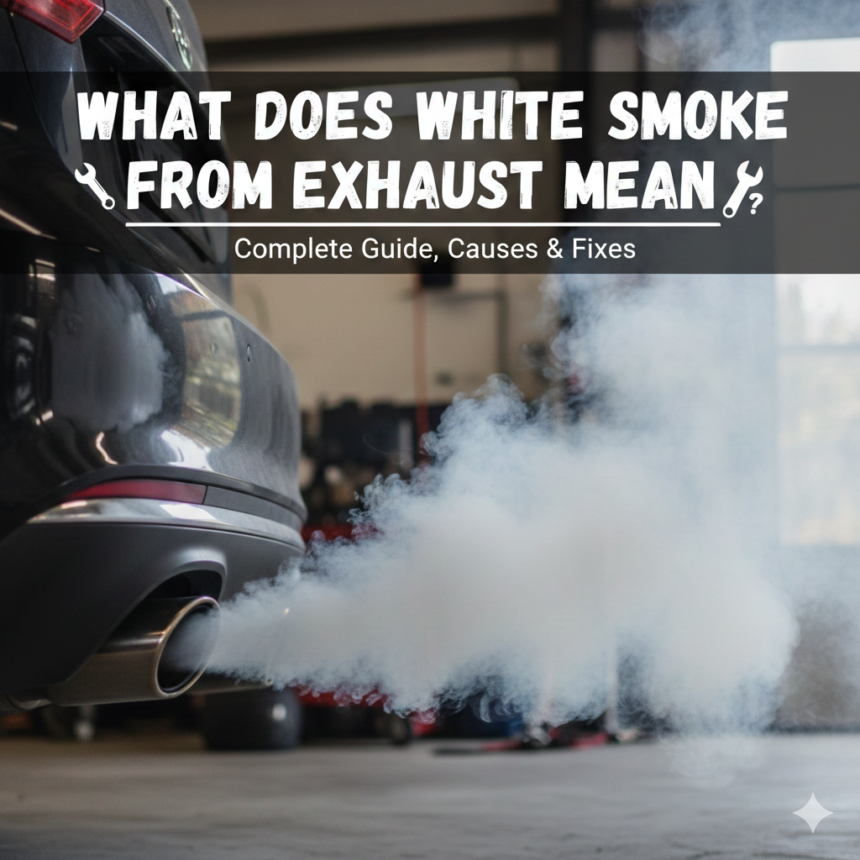
White smoke from the exhaust is essentially steam. When an engine burns fuel, it also consumes water produced during the combustion process. In many cases, white smoke is simply condensation that’s visible after a cold start on cool mornings or short trips where the engine doesn’t fully warm up. However, persistent or thick white smoke can indicate that something is leaking or failing inside the cooling system, head gasket, engine, or exhaust pathways.
Key ideas to grasp:
– Normal condensation during a cold start should clear within a minute or two as the exhaust system heats up.
– Persistent white smoke that continues after the engine is warm is not normal and warrants further inspection.
– The color and odor of the smoke matter: sweet, syrupy coolant smell points toward a coolant leak into the combustion chamber; a clean, steam-like white plume with no odor can be harmless condensation; a strong, chemical-like odor may indicate another coolant or additive issue.
## Common causes
Understanding the typical culprits helps you triage safely. Here are the most common causes of white smoke from exhaust, from least to most serious:
– Condensation at startup (normal): In cool climates, air and humidity can create visible steam that disappears after a short engine run.
– Coolant entering the combustion chamber (head gasket, cracked head, or cracked block): This causes persistent white smoke with a sweet coolant smell and often a rising coolant level or milky oil.
– Intake manifold or gasket leaks (for engines with intercoolers or turbochargers): Coolant or moisture can find its way into the intake tract, producing white smoke.
– Overfueling or flooded combustion (fuel control issues): In rare cases, too much unburned fuel can cause white smoke when the engine is cranking or starting, especially after a long period of inactivity.
– Transmission or coolant lines into the exhaust (rare in modern vehicles): Certain failures can route coolant or ATF into exhaust pathways, producing white smoke in unusual cases.
– Engine internals damage (cracked head, warped head, or cracked block): Severe damage can push coolant into the combustion chamber, creating thick white smoke that doesn’t clear with engine warm-up.
– Turbo or intercooler coolant leaks (in turbocharged engines): If a turbo seals fail or the intercooler is compromised, coolant can enter the intake and exhaust system, resulting in white smoke.
If you’re unsure which category applies, proceed with a cautious, methodical check rather than assuming the simplest cause.
## Symptoms / how to identify the problem
Identifying the underlying issue requires looking at several signs in combination with the smoke:
– Persistence: Condensation smoke should fade quickly once the engine warms. Ongoing white smoke suggests a coolant or engine problem.
– Cooling system symptoms: Coolant loss without visible leaks, overheating, or a sweet smell from the exhaust. Milky oil on the dipstick or under the oil cap indicates coolant mixing with oil.
– Oil condition: If the oil looks chocolate-milk colored or separated, coolant is likely leaking into the oil.
– Temperature behavior: Sudden overheating or continued high heat while smoke is present is a red flag.
– White smoke color/odor: Pure steam often lacks odor; coolant-contaminated smoke tends to have a sweet scent. Diesel or gasoline engines can produce different smoke characteristics—be mindful of your vehicle type.
– Other clues: Visible coolant puddles, steam from under the hood, or steam that you can see even after the engine is warmed up.
## Step-by-step troubleshooting guide
Follow these steps in order to safely diagnose without causing further damage. If you’re ever in doubt, stop and consult a professional.
– Step 1: Observe and document
– Note when the smoke appears (cold start vs. after driving),
– How long it lasts, and whether it changes with RPM or load,
– Any accompanying symptoms (overheating, rough idle, misfires).
– Step 2: Check the basics
– Open the hood when the engine is cool and look for obvious leaks or wet spots on hoses, the radiator, or the engine.
– Check coolant level in the reservoir and radiator (when cold). Note any sudden drops.
– Check engine oil for signs of coolant contamination (milky appearance).
– Step 3: Inspect for coolant in the exhaust path
– Use a flashlight to inspect the tailpipe for white, foamy smoke after a cold start—continued presence points toward a coolant issue.
– Look for a sweet smell in the exhaust. If present, coolant intrusion is more likely.
– Step 4: Perform a cooling system test
– Run a cooling system pressure test to look for leaks. A drop in pressure without an obvious external leak suggests a head gasket or internal leak.
– Consider a leak-down or compression test to evaluate cylinder integrity and head gasket condition.
– Step 5: Check for exhaust gas in the cooling system
– A block test kit (chemical tester) can detect combustion gases in the cooling system, indicating a head gasket or crack.
– If you have access to diagnostic equipment, a scan for misfires or sensor faults can also help.
– Step 6: Inspect for turbo/intercooler issues (turbo cars)
– If your vehicle is turbocharged, inspect the intercooler for coolant leaks and hoses for cracks or disconnections.
– Step 7: Diagnose common culprits
– If coolant is disappearing but the oil is clean, the head gasket or a small crack might be at play.
– If oil is milky, stop driving and pursue professional service immediately.
– Step 8: Decide next steps
– If tests point to a head gasket, cracked head, or engine block, plan for professional repair.
– If the issue is minor (e.g., a small coolant hose leak), a DIY repair or simple replacement may suffice.
## When repair is possible vs when to visit a mechanic
– DIY-friendly scenarios:
– Condensation smoke only on a cold start that disappears quickly.
– A visible small coolant hose leak or a loose clamp you can safely tighten.
– A straightforward coolant bleed or a simple radiator cap replacement.
– When to visit a mechanic urgently:
– White smoke persists after the engine reaches operating temperature.
– You notice coolant loss with no external leaks, or you see milky oil.
– The engine overheats, misfires, or the check engine light is on with related codes.
– You suspect a head gasket, warped head, or cracked engine component.
– You smell sweet coolant burning or experience a loss of power.
Professional diagnosis can save time and prevent further damage, especially with suspected head gasket failures, cracked heads, or turbo/intercooler leaks.
## Repair / Replacement Cost Estimates (USD)
Costs vary by vehicle type, engine design, and regional labor rates. Here are rough ranges to help with planning.
– Condensation smoke only (no fault found): usually $0 to $50 for inspection if you’re already diagnosing it yourself; otherwise negligible.
– Minor coolant leak (hose, clamp, or small reservoir cap): $50–$150 parts, $0–$200 total if DIY; $200–$500 if a shop performs the job.
– Radiator flush and coolant service: $100–$250.
– Head gasket replacement: $1,000–$2,500 for a small to mid-size car; $2,500–$4,500+ for a larger engine or premium vehicle.
– Cylinder head resurfacing or head replacement (if warped or cracked): $800–$2,500 for head work; plus labor, potentially total $1,500–$4,000.
– Engine block crack repair or replacement: highly variable; often $3,000–$8,000+ depending on engine size and availability of a replacement short block.
– Turbo/intercooler coolant leak repair: $600–$1,500 for parts and labor, depending on turbo and hoses.
– Intake manifold gasket replacement (specific to coolant leakage paths): $200–$700 in parts; $400–$1,200 including labor.
Note: Prices vary widely by region. In the United States, you’ll often see higher labor costs in urban areas and lower costs in rural regions. If a major diagnostic workup is needed, expect the total to rise by a few hundred dollars.
## Preventive tips
Prevention is cheaper than repair. Here are practical ways to minimize the risk of white smoke from exhaust:
– Maintain coolant levels and follow the manufacturer’s coolant change interval.
– Use the recommended coolant type for your vehicle; avoid mixing types.
– Regularly inspect hoses and clamps for cracks, leaks, or loosening.
– Allow the engine to reach operating temperature before aggressive driving, especially in cold weather.
– Keep an eye on oil level and color; check for milky appearance that suggests coolant mixing.
– Monitor for overheating or a sudden drop in performance and address early.
– Schedule periodic cooling system pressure tests during routine maintenance.
– If you own a turbocharged car, follow turbo maintenance guidelines and inspect the intercooler hoses for leaks.
## FAQs
– Q1: Is white smoke always dangerous?
– A: Not always. A brief white plume at startup in cold climates can be normal. Persistent white smoke, especially with signs of coolant loss or oily milkiness, is not normal and warrants inspection.
– Q2: How can I tell if the white smoke is coolant-related?
– A: Look for a sweet coolant smell, milky oil, rising coolant level, or overheating. Do a cooling system/pressure test and compression test if you suspect a head gasket.
– Q3: Can I drive my car if white smoke appears briefly?
– A: If it’s only during a cold start and clears quickly, driving to normal operation is usually fine. If it persists or you notice overheating, coolant loss, or unusual engine behavior, stop and get it checked.
– Q4: My car is diesel. Does white smoke mean the same thing?
– A: Diesel engines can emit white smoke from steam or unburnt fuel. Persistent white smoke could indicate fuel system issues, blocked injectors, or a coolant problem. Always treat it as a potential issue and check with a mechanic.
– Q5: What tests confirm a head gasket problem?
– A: A multi-step approach works well: compression or leak-down test, cooling system pressure test, and a block test to detect combustion gases in the coolant. A professional diagnostic scan can support the findings.
## Conclusion
White smoke from the exhaust can be a harmless, temporary condition or a sign of a serious mechanical issue. The key is to observe carefully, test when possible, and act prudently. Start by distinguishing whether it’s a simple condensation plume or a symptom of coolant intrusion or internal engine damage. If you’re ever unsure, err on the side of caution: a professional diagnosis is worth it to prevent further damage and avoid costly repairs down the line.
Have car problems? Ask in the comments and I’ll help!